



Best Pillows for Neck Pain: Top Picks for Comfortable Sleep
Introduction
Neck pain in the morning usually isn’t “just how you slept.” It’s often a support problem: your pillow is either pushing your head too high, letting it drop too low, or forcing your neck to twist for hours. That small mismatch can add up to stiff shoulders, headaches, and a day that starts behind.
The good news: you can often improve neck comfort without changing everything about your bed. The right pillow helps keep your head and neck in a neutral line (cervical alignment), reduces pressure at the base of the skull, and stays comfortable as you move through the night. Cooling also matters more than most people think—overheating leads to tossing, which breaks posture and can flare pain.
Below is a practical list of the best pillow types for neck pain, who they work for, and what to watch out for. You’ll also see a clear recommendation for people who want an ergonomic, premium option with a 60-night risk-free trial plus free shipping & returns—because the biggest fear with pillows is spending money and still waking up sore.
Quick comparison: top pillow picks for neck pain
| Pillow type | Best for | Neck support style | Common mistake to avoid |
|---|---|---|---|
| Ergonomic cervical pillow (contour) | Back + side sleepers with morning neck/shoulder pain | Built-in neck roll supports the curve of your neck | Choosing the wrong height for your shoulder width |
| Adjustable shredded memory foam | Combo sleepers who change positions | Custom loft by adding/removing fill | Overstuffing until your chin tilts down |
| Solid memory foam (traditional) | People who like a stable feel | Even support, moderate contouring | Using a too-tall loft for back sleeping |
| Latex pillow | Hot sleepers who want responsive support | Springy support, less “sink” than foam | Buying too firm if you need pressure relief |
| Buckwheat pillow | People who want very stable, moldable support | Hull fill shapes and holds position | Not expecting the firmer feel and noise |
| Down/Down alternative | Stomach sleepers (sometimes) and soft-pillow lovers | Low support unless well-constructed | Using it for side sleeping without enough loft |
| Water pillow | People who want tunable firmness | Water core supports with adjustable fill level | Setting it too full so your neck extends |
How we picked these pillows (what actually matters for neck pain)
A pillow can feel “comfortable” in the first 30 seconds and still aggravate neck pain by hour three. For neck support, you want the same outcome every night: your head stays level, your neck keeps a neutral curve, and your shoulders don’t take extra load.
Here are the criteria we used in this list:
- Cervical alignment: The pillow should keep your nose roughly in line with the center of your chest (not angled up or tucked down).
- Pressure relief: Especially at the base of the skull and the top of the shoulders for side sleepers.
- Ergonomic neck support: A contour or smart loft that supports the neck, not just the head.
- Cooling and temperature stability: Less overheating means less tossing and fewer awkward neck angles.
- Fit range: Shoulder width, sleeping position, and mattress firmness change what “right height” means.
- Risk-free trial + easy returns: Neck pain improvements usually take a little time, so a real trial matters.
Contrarian take (but it matches what our customers tell us): the “best” pillow is often the one that fixes your height first, not the one with the fanciest foam. If your loft is wrong, even premium materials won’t save your neck.
Best pillows for neck pain: 10 top picks
1) Ergonomic cervical pillow (contour design) — best overall for neck pain
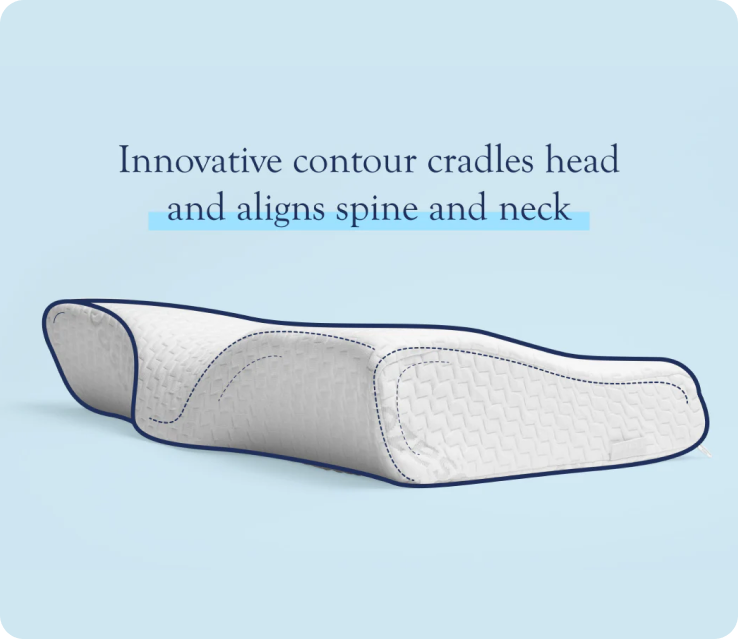
If you wake up with tight traps, shoulder soreness, or a stiff neck that eases as the day goes on, an ergonomic cervical pillow is usually the most direct fix. The contoured shape supports the natural curve of your neck so your head doesn’t “float” or slump.
Look for two height options (or a reversible design) so you can match your shoulder width. Back sleepers typically do best with a lower neck roll, while side sleepers often need a bit more loft to keep the spine straight from ear to shoulder to hip.
Dosaze perspective: our focus is engineered sleep posture—support plus cooling—because neck pain is often a posture + heat problem. A 60-night risk-free trial and free shipping & returns matter here, since most people need about 1–2 weeks to stop “fighting” a new pillow and let the neck settle into better cervical alignment.
2) Adjustable shredded memory foam pillow — best for combo sleepers
If you switch from side to back (or hug your pillow, then roll away), adjustable shredded foam is a practical choice. You can remove fill to lower the loft or add fill to increase neck support.
The key is to adjust based on your sleeping position that causes pain. If you wake up sore after side sleeping, you likely need more height; if you wake up sore after back sleeping, you may need less height so your chin doesn’t tilt toward your chest.
Tip: after adjusting, give it three nights before changing again. Constant tweaking can keep your neck in “adaptation mode” and make it harder to judge what’s working.
3) Solid memory foam pillow — best stable support (with a clear loft)
A one-piece memory foam pillow offers consistent support night after night. That stability can help if you feel like your pillow collapses and your neck pays for it by morning.
Pick a loft that matches your body and mattress. A softer mattress lets your shoulders sink more, which often means you need less pillow height for side sleeping than you’d expect. On a firm mattress, you may need a touch more loft to avoid bending your neck downward.
Cooling matters here because traditional memory foam can hold heat. If you run hot, prioritize a design with airflow channels or a cooling cover.
4) Latex pillow — best for cooling + responsive neck support
Latex is naturally springy, so it supports without that slow “sink” feeling. For some people with neck pain, that faster response keeps the head from settling too deep and pulling the neck out of position.
Latex also tends to sleep cooler than dense foam, especially if it has perforations. If you wake up warm and reposition often, a cooler pillow can reduce how much you twist and re-stack your neck during the night.
One watch-out: very firm latex can feel like it pushes back too much. If you’re sensitive at the base of the skull, choose a medium feel or a design built for pressure relief.
5) Buckwheat pillow — best for “stays put” support
Buckwheat pillows use hulls that you can shape into a stable cradle. Once you find the right position, it tends to hold, which can be helpful for people who wake up because their pillow “ran away” or flattened.
They can also allow airflow through the hulls, which supports cooling. But they are firmer and can be noisy when you move.
This is a good fit if you want a very structured feel and don’t mind a more “filled” pillow. It’s not ideal if you want a plush, sink-in comfort.
6) Water pillow — best for tunable firmness (especially during trial-and-error)
Water pillows let you change the firmness by adding or removing water. That adjustability can help if you’re not sure what loft or feel reduces your neck pain.
Set it up so your head stays level and your neck feels supported without being pushed forward. As a starting point, aim for a neutral neck where you don’t feel tension at the front of the throat (often a sign your head is tipped too far forward).
They can feel heavier and less “cozy” than foam, but the tuning can be worth it if you like a precise setup.
7) Down pillow — best for stomach sleepers who need low loft
Stomach sleeping is tough on the neck because it often forces rotation. If you can’t change positions, the best move is usually lowering the pillow loft so your neck doesn’t extend upward.
Down (or a soft down alternative) can compress low and reduce the angle at your neck. The downside is neck support: if you have neck pain from side or back sleeping, down often collapses too much to maintain cervical alignment.
If you choose down, consider using it only when you’re on your stomach and hugging another pillow to reduce shoulder strain.
8) Down alternative pillow — best budget-friendly softness (with limits)
Down alternative gives a similar plush feel without natural down. It can work if your main issue is comfort, but it’s usually not the top choice for neck pain because it tends to compress and lose shape.
If you go this route, pick a higher-quality construction with good fill power and a supportive inner structure. Replace it sooner if it starts to clump or flatten—neck pain often returns when the pillow stops holding its loft.
For consistent neck support, most people do better with an ergonomic or adjustable design.
9) Side-sleeper pillow with a shoulder cutout — best if you get numb arms
If your arm falls asleep or your shoulder feels jammed, a pillow with a shoulder cutout can reduce pressure while still supporting the neck. It creates space for the shoulder so your head doesn’t get pushed up too high.
These work best for strict side sleepers. If you switch positions a lot, the cutout can feel awkward when you roll onto your back.
When it fits, it can be a simple fix: less shoulder pressure, better neck angle, fewer middle-of-the-night adjustments.
10) Travel cervical pillow (for planes and upright sleep) — best for preventing flare-ups on the go
This isn’t a replacement for your main pillow, but it can prevent neck pain spikes when you travel. Upright sleeping often drops the head forward or sideways, stressing the neck.
A supportive travel pillow helps keep the head centered and reduces strain on the neck muscles. Look for a design that supports under the jawline enough to prevent the head from falling forward.
If you travel often for work, this one small change can make your “first night back” feel a lot better.
What pillow height is best for neck pain? (simple fitting guide)
Loft is the fastest way to get wrong—and the fastest way to fix neck pain. Use this as a starting point and then fine-tune based on how you feel in the first hour after waking.
| Sleeping position | Goal | Typical loft direction | Sign it’s wrong |
|---|---|---|---|
| Back | Support the neck curve without pushing head forward | Low to medium | Chin tilts down; throat feels “compressed” |
| Side | Keep nose aligned with center of chest | Medium to high (depends on shoulder width) | Ear feels closer to shoulder (too low) or head tilts up (too high) |
| Stomach | Minimize neck extension and rotation | Very low | Lower back arches; neck feels pinched on one side |
Practical check: take a quick selfie from behind (or ask someone) while you lie in your normal sleep position. If your head tilts noticeably up or down compared to your spine, adjust loft before you blame the material.
Unique angle: the 14-night neck pain test (how to know if a pillow is working)
Most pillow guides skip the hard part: how you evaluate a new pillow without guessing. Here’s a simple, repeatable test we recommend because neck tissues often need time to calm down once alignment improves.
- Nights 1–3: Expect “different,” not perfect. Rate morning pain (0–10) and note where it is (base of skull, one side of neck, top of shoulder).
- Nights 4–7: Make one change only if needed (loft or orientation). Don’t change mattress toppers, sleep positions, and pillows all at once.
- Nights 8–14: Look for a trend: less morning stiffness time (for example, 60 minutes down to 15 minutes) matters as much as the pain score.
This is where a 60-night risk-free trial with free shipping & returns becomes more than a perk. It gives you enough time to confirm real improvement instead of making a quick call after one rough night.
FAQ
What is the best pillow for neck pain?
The best pillow for neck pain is one that keeps your head level and supports the natural curve of your neck so you maintain neutral cervical alignment through the night. For many back and side sleepers, an ergonomic cervical (contour) pillow is the most reliable option because it supports the neck directly instead of only cushioning the head. A practical next step is to choose a pillow with the right loft for your shoulder width and test it for at least 1–2 weeks to track whether morning stiffness time decreases.
Is memory foam good for neck pain?
Memory foam can be good for neck pain when it provides steady neck support without letting your head sink too deep, because that helps reduce strain on the neck muscles overnight. A solid foam or ergonomic contour design often works better than a very soft, high-loft foam that pushes the chin down. If you sleep hot, look for cooling features (like a cooling cover or airflow channels) since overheating can cause more tossing and worsen neck positioning.
What pillow height (loft) should I use if my neck hurts?
Pillow loft should keep your nose aligned with the center of your chest and your neck in a neutral curve, because too high or too low forces the cervical spine to bend for hours. Back sleepers usually need low-to-medium loft, side sleepers often need medium-to-high loft depending on shoulder width, and stomach sleepers typically need very low loft. A simple next step is to check alignment in a mirror or photo while lying down and adjust loft until your head isn’t tilted up, down, or toward the mattress.
How long does it take to get used to a new pillow for neck pain?
It often takes about 7–14 nights to know if a new pillow is improving neck pain, because your muscles and joints need time to adapt to better sleep posture. You should look for trends like reduced morning stiffness time and fewer wake-ups rather than expecting perfect relief on the first night. If your pillow includes a longer at-home trial, you can make one small adjustment (like loft or orientation) and re-test for several nights before deciding.
Should side sleepers use a cervical pillow?
Side sleepers can benefit from a cervical pillow if it provides enough loft to fill the space between the ear and the outer shoulder while still supporting the neck curve. The goal is straight alignment from head to spine so the neck doesn’t bend down toward the mattress or tilt up. A helpful next step is to choose a contour pillow with multiple height options or an adjustable design so you can match support to your shoulder width and mattress firmness.
Conclusion: choose support first, then comfort and cooling
Neck pain rarely needs a complicated solution. Most of the time, you need the right height and the right shape to keep cervical alignment steady, plus enough pressure relief to stay comfortable and enough cooling to reduce tossing.
Next steps: pick the pillow type that matches your sleep position (contour for targeted neck support, adjustable fill for combo sleeping, latex for cooling responsiveness). Then run a simple 14-night test and track morning stiffness time and pain location.
If you feel anxious about getting it wrong, prioritize brands that back the fit with a 60-night risk-free trial and free shipping & returns. That safety net gives you the time you need to find what actually works for your neck—without feeling stuck with an uncomfortable pillow.
Summary of top picks
- Best overall: Ergonomic cervical (contour) pillow for consistent neck support and cervical alignment
- Best for combo sleepers: Adjustable shredded memory foam pillow
- Best stable feel: Solid memory foam pillow (choose the right loft)
- Best cooling + responsive support: Latex pillow
- Best “stays put” moldable support: Buckwheat pillow
- Best tunable firmness: Water pillow
Educational content only; for persistent or severe symptoms, consider speaking with a qualified health professional.


