



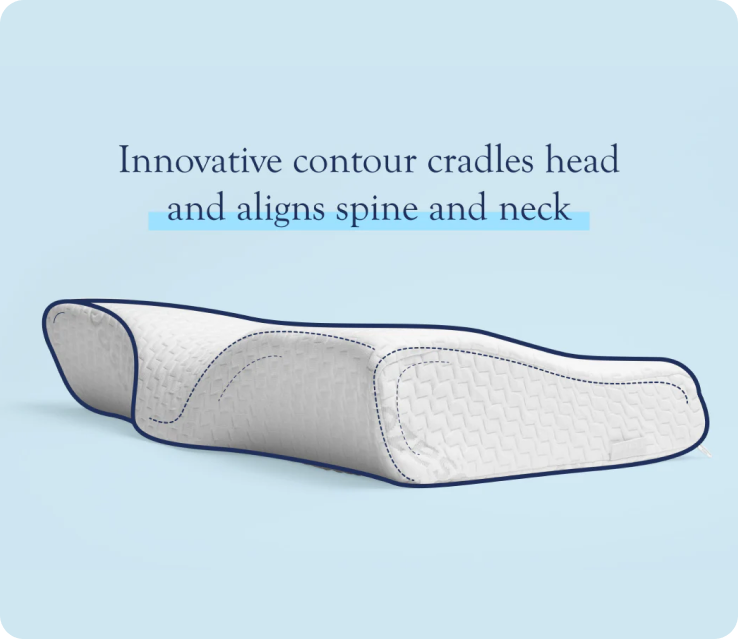
The Best Pillow for Side Sleepers Isn't What Most People Think
Ask anyone what the best pillow for side sleepers is, and you'll get a dozen different answers. Memory foam. Latex. Down alternative. Extra-firm. Adjustable fill. The options are endless, the marketing is loud, and most of it misses the point entirely.
Here's my honest opinion: the conversation about pillows for side sleepers has been hijacked by material wars and buzzwords, when the only question that actually matters is this — does your pillow keep your spine in a neutral line from your hips to the top of your head? If it doesn't, nothing else about it matters.
Side Sleeping Is the Most Demanding Position for a Pillow
Let's start with the physics. When you sleep on your side, your shoulder creates a significant gap between your head and the mattress. That gap — which varies based on shoulder width, mattress firmness, and your own anatomy — needs to be bridged precisely. Not approximately. Precisely.
Back sleepers need modest support. Stomach sleepers (who really should reconsider that habit) need almost none. But side sleepers? They're asking a pillow to do serious structural work for six to eight hours straight. A pillow that's even slightly too thin lets your neck drop. One that's too thick pushes it upward. Either way, you're waking up stiff, achy, and reaching for the coffee maker before your eyes are fully open.
This is why I'd argue that loft — the height and firmness of a pillow — is more important than fill material for side sleepers. Yet most pillow marketing leads with material. It's a backwards conversation.
The Loft Problem Nobody Talks About Honestly
Walk into any bedding section and you'll see pillows labeled firm, medium, or soft. Occasionally you'll see a loft measurement in inches. What you rarely see is guidance on which loft is right for your shoulder width and your mattress.
This is a real problem. A petite person sleeping on a plush mattress — where their shoulder sinks in — needs a completely different loft than a broad-shouldered person sleeping on a firmer surface. The same pillow will work beautifully for one and be a neck-ache machine for the other.
My strong opinion: the best pillow for a side sleeper is one with adjustable loft, or one that has been chosen based on their specific body and sleep setup — not one chosen because it was heavily advertised or came in a satisfying box.
Adjustable fill pillows, typically filled with shredded foam or a blend of materials you can add or remove, have become popular for exactly this reason. They put the decision-making back in your hands, which is where it belongs. [LINK: Dosaze pillow collection]
Does Material Actually Matter? Yes — But Less Than You Think
I don't want to dismiss fill material entirely. It does matter. Just not first.
Once you've established the right loft, material affects a few important things:
- Pressure relief: Memory foam contours around your head and neck, distributing weight evenly and reducing localized pressure around the ear and temple.
- Temperature regulation: Traditional memory foam can trap heat. Latex and newer open-cell foam formulations tend to sleep cooler — worth considering if you run warm at night.
- Responsiveness: Latex bounces back quickly when you shift positions. Memory foam is slower. If you move around a lot overnight, this changes your experience significantly.
- Durability: Down and down-alternative pillows tend to flatten and lose loft faster than foam or latex. For side sleepers who depend on precise loft, this is a real long-term cost consideration.
So yes — material matters. But it's the second decision, not the first.
The Counterargument: Isn't This All Just Personal Preference?
I hear this one often. And there's some truth to it. Sleep is deeply personal. Comfort is subjective. Some people genuinely love a soft, fluffy pillow even if a stricter analysis would say it's wrong for their posture.
But here's where I push back: most people don't know what a properly supported night's sleep actually feels like. They've slept with the wrong pillow for so long that they've normalized the morning stiffness, the shoulder tension, the interrupted sleep. They think that's just how sleep feels for them.
It isn't. Spinal alignment during sleep isn't a luxury preference — it's a functional requirement. When your cervical spine is misaligned for hours at a time, night after night, the body responds. You feel it in your neck, your upper back, sometimes even in headaches and jaw tension. Personal preference should operate within the bounds of what's actually supportive, not instead of it.
This is also why pillow choice is inseparable from mattress choice. A firmer mattress changes the shoulder gap. A softer mattress changes it differently. If you upgrade your pillow without considering your sleep surface — or vice versa — you're solving half the equation. [LINK: sleep quiz]
What I'd Actually Recommend
If I had to give a direct, opinionated answer on the best pillow for side sleepers, it would look like this:
- Choose a pillow with a loft between 4 and 6 inches as a starting point, adjusting based on your shoulder width and mattress firmness.
- Prioritize adjustability if you're unsure — shredded foam or adjustable fill gives you room to dial it in.
- Go with latex or open-cell foam if you sleep warm; memory foam if you want maximum contouring.
- Replace your pillow more often than you think you need to — most pillows lose meaningful support within 18 to 24 months.
- Consider your mattress as part of the equation. A pillow is not a standalone solution.
And above all: test, adjust, and trust how you actually feel in the morning. A great pillow should be something you don't notice — because nothing hurts.
The Bigger Picture
We spend roughly a third of our lives lying down. The idea that a pillow is a minor purchase — something to grab off a shelf without much thought — is one of the stranger cultural blind spots we have around sleep. Side sleepers especially pay the price for that indifference, because their position is the most mechanically demanding.
The best pillow for side sleepers isn't the most expensive one, or the one with the most five-star reviews, or the one that arrived in the most impressive packaging. It's the one that holds your head, neck, and spine in alignment while you sleep — night after night, without making you think about it.
That's the standard worth caring about.
If you're ready to find yours, explore the Dosaze pillow range — designed with sleep posture and long-term support at the center of every decision. And if you're not sure where to start, our [LINK: sleep quiz] can help you figure out exactly what your sleep setup needs. Your neck will thank you.


