


The Best Pillow for Side Sleepers: Why Most People Are Getting It Wrong
Let's Be Honest: Most Pillows Are Not Designed for How You Actually Sleep
Walk into any bedding aisle or scroll through any sleep retailer and you'll find dozens of pillows marketed to side sleepers. Cooling covers. Shredded memory foam. Bamboo fill. Adjustable loft. The options are overwhelming — and most of them are, frankly, overengineered in the wrong direction.
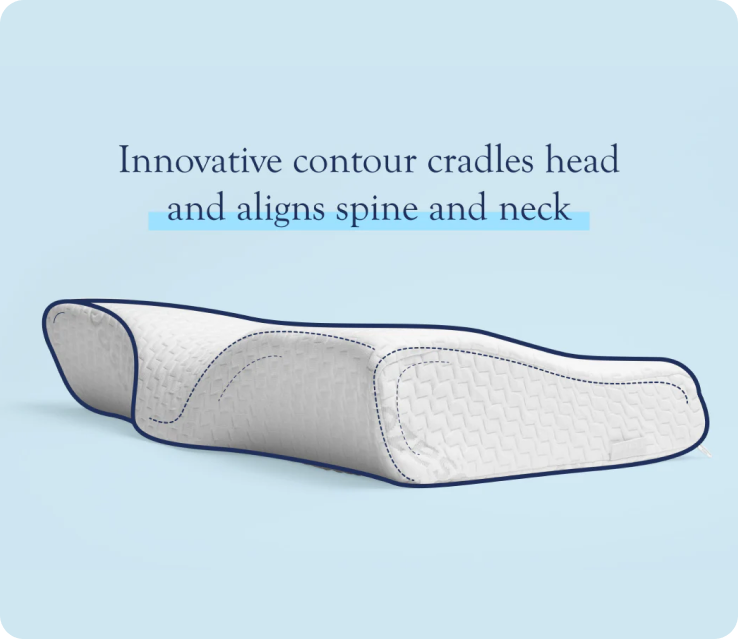
Here's our take: the best pillow for side sleepers isn't the one with the longest feature list. It's the one that solves a single, non-negotiable problem — keeping your spine in a neutral, straight line from your neck all the way to your hips. Everything else is secondary.
And yet, the sleep industry keeps selling softness, scent, and aesthetics while quietly ignoring alignment. That's a problem worth talking about.
Why Side Sleeping Demands More From a Pillow
Side sleeping is, by most accounts, the most popular sleep position. It's also the position most associated with reduced snoring, better digestion, and improved circulation. But it comes with a structural challenge that back and stomach sleepers don't face in the same way: the gap between your head and the mattress is significant.
When you lie on your side, your shoulder creates a distance — typically three to six inches depending on your build — between the surface of your mattress and where your head naturally falls. A pillow that's too flat lets your head drop. A pillow that's too thick pushes your neck upward at an angle. Either way, your cervical spine is under stress all night long.
This is why side sleepers are disproportionately likely to wake up with neck stiffness, shoulder tension, or unexplained headaches. The pillow isn't just a comfort accessory — it's a structural support tool. Treating it like anything less is where most people go wrong.
The Loft Question: Why Firm and Fluffy Miss the Point
The conversation around pillows usually gets reduced to firmness. Firm pillows for side sleepers, soft pillows for stomach sleepers — it's a rule of thumb that gets repeated endlessly, and it's not entirely wrong. But it's incomplete in a way that matters.
What side sleepers actually need is consistent, reliable loft — meaning the pillow needs to maintain its height under the weight of your head throughout the night, not just when you first lie down. A fluffy pillow may feel luxurious in the first hour and completely collapse by 3am. A memory foam pillow might hold its shape beautifully but trap heat in a way that disrupts your sleep architecture.
The best pillow for a side sleeper holds its loft, keeps your head at the right height for your specific shoulder width, and doesn't force your body to compensate throughout the night. That's the standard we should be measuring against — not thread count or marketing claims about cloud-like comfort.
The Case for Adjustability (And Its Limits)
Adjustable fill pillows have become increasingly popular, and there's genuine merit to the concept. The idea is simple: remove or add fill until the loft is right for you. For side sleepers who have struggled to find a pillow that fits their shoulder width, adjustability can be genuinely useful.
But here's the counterpoint worth making: most people don't adjust their pillows. They set it up once, sleep on it, and never revisit the fill level even as the material compresses over time. Adjustability is only a feature if you actually use it. And the fill materials in many adjustable pillows — loosely packed foam clusters, for instance — can shift unpredictably during the night, creating uneven support that's arguably worse than a well-constructed fixed-loft option.
Our position: adjustability is a useful tool for people who are willing to engage with it. If you're not, a well-designed pillow with the right fixed loft for your build will serve you better.
What Actually Matters When Choosing a Pillow as a Side Sleeper
Rather than chasing trends, here's what we think deserves your attention:
- Shoulder width and body frame: Broader shoulders typically need a higher loft. Petite frames need less. This is the single most important variable most people never consider.
- Mattress firmness: A softer mattress allows your shoulder to sink in, reducing the gap your pillow needs to fill. A firmer mattress keeps you higher up, requiring more loft. Your pillow and mattress work as a system. [LINK: Dosaze mattress collection]
- Fill durability: How does the pillow perform after six months? After a year? A pillow that's perfect on day one but compresses by month three is not a good pillow — it's a deferred problem.
- Temperature regulation: Sleep quality is closely tied to body temperature. If your pillow traps heat, your sleep will suffer regardless of how well it supports your neck. Look for materials that breathe.
- Sleeping position consistency: If you shift between side and back during the night — which many people do — a mid-loft pillow with some adaptability may serve you better than an ultra-high loft designed strictly for committed side sleepers.
The Opinion You Didn't Ask For (But We'll Give Anyway)
The sleep industry has a tendency to solve problems with complexity. A pillow that isn't working gets replaced with a pillow that has more features, more layers, a fancier fill material, a higher price point. But the underlying question — does this keep my spine aligned while I sleep? — often goes unanswered.
We think the best pillow for side sleepers is one that was designed with alignment as the primary objective, not comfort as the primary marketing angle. Comfort matters. But comfort built on a foundation of poor support is just a more pleasant version of the same problem.
If you've cycled through multiple pillows and still wake up with neck tension or disrupted sleep, the answer probably isn't a new fill material. It's a more honest look at the geometry of your sleep position — and a pillow designed to actually address it. [LINK: sleep quiz]
The Bottom Line
Side sleepers deserve better than the generic advice that dominates most pillow buying guides. The best pillow for a side sleeper isn't the softest, the most adjustable, or the most heavily marketed. It's the one that keeps your head, neck, and spine in genuine alignment — consistently, all night long, for months and years after purchase.
That's the standard worth holding. And it's the one we design toward.
If you're ready to stop guessing and start sleeping better, explore the Dosaze pillow and sleep system range — built around the science of alignment, not just the language of comfort. [LINK: Dosaze pillow collection]