



Best pillow for keeping neck aligned all night: Top picks
Introduction
If you wake up with a stiff neck, tight shoulders, or a dull headache that fades after coffee, your pillow may be letting your head drift out of line for hours. Good cervical alignment is simple in theory: your neck should stay in a neutral position so muscles can relax and joints are not held at an odd angle. In practice, it is hard because we change positions, mattresses vary, and many pillows are either too tall, too flat, or too soft to hold their shape.
This list focuses on pillows that keep the neck aligned all night by doing two things well: maintaining height under the neck (neck support), and letting your head settle without creating pressure points (pressure relief). Cooling matters too, because heat can make you toss and turn, which breaks alignment.
You will see clear "best for" picks, plus a practical way to choose the right loft and firmness without guesswork. If you are anxious about spending money on another pillow, pay attention to the return terms. A real trial, like Dosaze's 60-night risk-free trial with free shipping & returns, changes the decision from "hope it works" to "test it at home."
How a pillow keeps your neck aligned (and why most fail)
Neck alignment means your nose stays in line with the center of your chest when you sleep on your back, and your nose stays in line with the center of your sternum when you sleep on your side. If your pillow is too high, your chin tucks toward your chest. If it is too low, your head falls back or your ear drops toward the mattress.
Most pillows fail because they change height during the night. Fluffy fiberfill compresses. Soft foam can let your head sink until your neck bends. Even a "supportive" pillow can be wrong if its loft does not match your shoulder width and mattress firmness.
A quick at-home alignment check
Lie down in your normal sleep position and take a photo from the side at mattress level (or ask someone to). You want a straight line from the center of your forehead through the base of your neck to the top of your chest. If you see a bend, adjust loft or switch pillow style.
What to look for in the best pillow for keeping neck aligned all night
- Ergonomic shape that supports the neck: A cervical contour or a built-in neck bolster helps keep height where your neck needs it, not just under your head.
- Stable loft: Look for materials that resist flattening and spring back after pressure.
- Pressure relief at the head: Too firm can create hot spots that make you move more.
- Cooling: Breathable covers and cooling materials reduce overheating and position changes.
- Return policy that removes the risk: A true in-home trial is a practical filter, not marketing.
Top picks: Best pillows for keeping neck aligned all night
These picks are grouped by the most common reasons people lose cervical alignment: wrong shape, wrong loft, overheating, or frequent position changes. Each option has a clear "best for," plus what to watch out for.
-
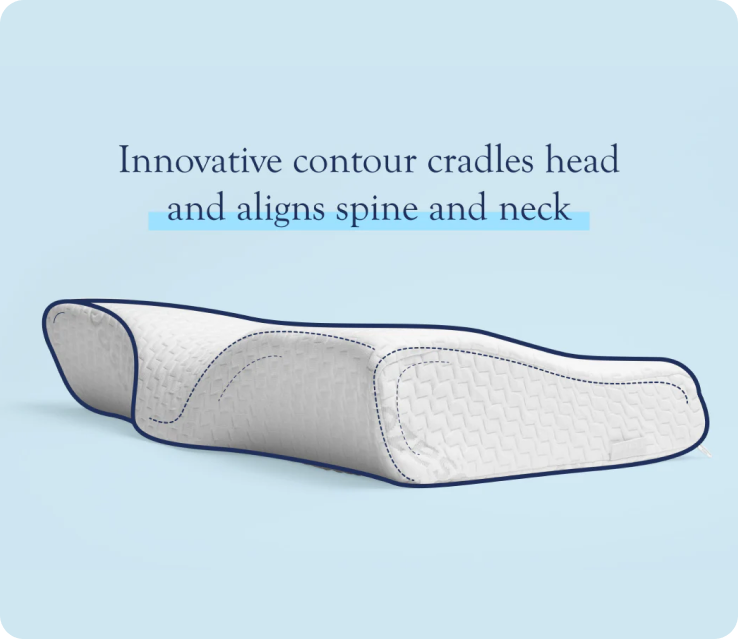
Dosaze ergonomic cervical pillow (best overall for consistent neck support)
If your main goal is cervical alignment that stays steady from bedtime to morning, an ergonomic cervical pillow is the most direct solution. The contoured shape supports the curve of your neck, which helps keep your head from rolling into an awkward angle when you relax into sleep.
Dosaze designs its ergonomic pillow around sleep posture first, then comfort. The materials are chosen for a balance of support and pressure relief, so your neck gets structure while your head settles without a hard "ledge" feeling. Cooling also matters here, because less heat usually means fewer mid-night adjustments that break alignment.
Why this is a low-risk pick: Dosaze includes a 60-night risk-free trial with free shipping & returns, which is the right time window for your neck to decide if the new posture feels better or just different.
-
High-loft contour memory foam pillow (best for broad shoulders and side sleepers)
Side sleepers with broader shoulders need more height between the mattress and the side of the head. A higher-loft contour pillow fills that gap while still leaving a dedicated "channel" for the neck, which helps prevent your head from tilting down toward the mattress.
Choose a contour design with a firmer neck ridge and a slightly softer head cradle. That structure keeps the neck supported, while pressure relief at the temple reduces the urge to roll forward.
Watch out for: High loft on a soft mattress can push your head up too far. If your mattress is plush, you often need less pillow height than you think because your shoulder sinks in.
-
Medium-loft adjustable foam pillow (best for mixed sleepers who change positions)
If you switch between back and side during the night, fixed-height pillows can be hit or miss. An adjustable pillow (usually shredded foam) lets you remove or add fill so you can dial in a height that keeps alignment in both positions.
A practical target: set the pillow so your neck feels "held" when on your back, but your head does not tip toward your chest. Then roll to your side and confirm your nose stays centered, not angled down.
Watch out for: Some shredded fills shift and clump. You want an adjustable pillow that stays even, or you will spend too many nights re-fluffing to regain neck support.
-
Latex contour pillow (best for springy support that does not flatten)
Latex has a different feel from memory foam. It pushes back more quickly, which helps it keep loft and support through the night. For cervical alignment, that resilience matters because the neck support does not slowly "melt away" under pressure.
A latex contour pillow works well if you want a stable, buoyant feel with solid pressure relief. Many people who dislike the slow sink of memory foam find latex easier to settle into while still feeling supported.
Watch out for: Latex can feel too bouncy for some sleepers. If you prefer a deeper cradle, choose a design with a softer top surface or a plush cover.
-
Cooling gel memory foam contour pillow (best for hot sleepers who toss and turn)
Overheating is an alignment problem. When you get warm, you move more, and each repositioning is a chance for your neck to end up bent. A cooling gel memory foam contour pillow aims to reduce heat buildup while keeping a cervical shape.
Look for two cooling layers: a breathable cover plus a cooling foam or gel layer. Cooling gel alone is not enough if the cover traps heat.
Watch out for: Some "cooling" gels feel cool at first touch but do not stay cool. Prioritize airflow and moisture-wicking fabrics over gimmicky coatings.
-
Thin, supportive back-sleeper pillow (best for smaller frames and firm mattresses)
If you are a back sleeper with a smaller frame, a thick pillow can push your head forward and strain the back of the neck. A thinner pillow with stable support can keep your cervical spine closer to neutral.
The goal is simple: enough height to fill the natural curve of the neck, but not so much that your chin drops toward your chest. A subtle neck roll or a gentle contour can help.
Watch out for: Thin pillows that are too soft collapse under the neck. You want thin and supportive, not thin and flat.
-
Side-sleeper pillow with a shoulder cutout (best for reducing forward head tilt)
Some side sleepers angle their shoulder forward, which lowers the space under the neck and can make the head tip forward. A pillow with a shoulder cutout creates room for the shoulder and helps keep the head stacked over the spine.
This style can be useful if you feel like your pillow pushes against your shoulder or if you wake up with your chin slightly tucked and your upper traps tight.
Watch out for: Cutout pillows can feel strange for the first few nights. Give it a week before you decide, and keep an eye on whether your head stays centered or starts drifting off the cutout.
-
Supportive travel pillow for alignment on planes and long car rides (best for neck position on the go)
Travel is where neck alignment often disappears. Slumped seats and head bobbing can leave you sore before you even get to your destination. A supportive travel pillow helps keep your head from falling to one side and tugging on the neck.
Look for a design that supports under the jawline and along the sides of the neck, not just a soft U-shape. If the pillow only fills space, it will not keep your cervical alignment steady.
Watch out for: Overstuffed travel pillows can push the head forward. On a plane seat, forward head posture is a fast way to wake up stiff.
-
Firm pillow for stomach sleepers (best for minimizing neck rotation)
Stomach sleeping is tough on cervical alignment because the neck is rotated for hours. If you cannot change positions yet, the best move is often to reduce how far your neck has to turn.
A very low-profile pillow or even no pillow under the head can help keep the neck closer to neutral. Some stomach sleepers do better placing a small pillow under the pelvis to reduce low-back strain, which can also reduce full-body tension that creeps up into the neck.
Watch out for: If stomach sleeping causes regular pain, consider training yourself toward side sleeping with a body pillow. It is not instant, but it is one of the most practical posture shifts you can make.
-
Premium down-alternative pillow with gusseted sides (best if you want plush feel with better structure)
If you love a plush pillow but hate waking up folded in half, look for a gusseted design. The side panel (gusset) helps the pillow keep a more consistent height than a basic bag-style pillow.
This can be a decent compromise for sleepers who want softness on the surface but still need enough structure to keep the head from sliding into a low spot. Pairing a gusset with a firmer fill improves long-night loft stability.
Watch out for: Plush fills still compress over time. Plan to replace sooner than foam or latex if alignment is your top priority.
Quick comparison table: Which pillow type keeps neck alignment best?
| Pillow type | Best for | Neck alignment strength | Main tradeoff |
|---|---|---|---|
| Ergonomic cervical contour (foam) | Neck/shoulder pain, posture support | High | Adjustment period of a few nights |
| High-loft contour (foam) | Broad shoulders, side sleeping | High | Can be too tall on plush mattresses |
| Adjustable shredded foam | Mixed sleepers, unsure about loft | Medium-high | Fill can shift or clump |
| Latex contour | People who want springy, stable loft | High | Feels bouncier than memory foam |
| Cooling gel contour (foam) | Hot sleepers who move a lot | Medium-high | Some cooling claims are short-lived |
| Gusseted down-alternative | Plush feel with a bit more structure | Medium | Compresses faster than foam/latex |
How to pick the right loft in 60 seconds
If you want a fast method that works in the real world, match pillow loft to your shoulder width and mattress firmness.
- Side sleepers: Start with a loft that roughly matches the distance from the outside of your shoulder to the base of your neck when standing relaxed. On a soft mattress, go 10-20% lower because your shoulder sinks in.
- Back sleepers: Start lower than you think. Your goal is to fill the neck curve, not prop the head up.
- Combination sleepers: Bias toward side-sleeper height, then choose an ergonomic contour or adjustable fill so the back-sleeping position still feels neutral.
A contrarian take that matches what we hear from customers: if a pillow feels "instantly perfect" because it is fluffy and tall, it is often too high after 30 minutes when your shoulders relax and the fill compresses. Stable support usually feels a bit firmer on night one, then more comfortable as your body stops guarding.
How long to test a new pillow before you judge it
Give a new ergonomic pillow at least 7-14 nights unless you feel sharp pain. Your neck muscles can be tight from months of poor support, and a better posture can feel unfamiliar at first.
If the pillow is wrong, you will see consistent signs: numbness in the arm, a headache that starts at the base of the skull, or waking up worse every day. That is when a real return policy matters. Dosaze's 60-night risk-free trial is long enough to test weekend sleep, stressful workweeks, and different sleep positions without feeling stuck.
FAQ
-
What is the best pillow for keeping your neck aligned all night? Keeping your neck aligned all night depends on stable loft and true neck support, not just softness. The best choice for most people is an ergonomic cervical pillow with a contoured shape that supports the neck while letting the head settle for pressure relief. If you are unsure on height, choose a pillow with a trial long enough to test alignment across several weeks, such as a 60-night risk-free trial with free shipping and returns.
-
How do I know if my pillow is too high or too low for cervical alignment? Loft matters because a pillow that is too high tucks your chin and a pillow that is too low lets your head fall back or sideways. A simple rule is this: on your back, your nose should point straight up; on your side, your nose should point straight out, not down toward the bed. Take a side photo at mattress level and adjust loft until your neck looks neutral and your shoulder is not being pushed forward.
-
Is memory foam or latex better for neck alignment? Both can support cervical alignment if the pillow holds its shape and matches your loft needs. Memory foam is better if you want a deeper cradle and strong pressure relief, while latex is better if you want springy support that resists flattening through the night. If you wake up with your neck feeling "collapsed" into the pillow, latex or a firmer contour foam usually fixes that faster than a softer foam.
-
Why do I wake up with neck pain even after buying a supportive pillow? Neck pain in the morning often comes from a mismatch between pillow loft, sleep position, and mattress softness, even if the pillow itself is high quality. A supportive pillow that is the wrong height can hold your neck in a bent position for 6-8 hours, which leaves muscles tight when you wake. Recheck alignment with a side photo, then adjust loft or switch to an ergonomic contour designed for neck support rather than a flat, compressible fill.
-
How long should I try a new pillow before returning it? Your body needs enough time to adapt to a new sleep posture, especially if your old pillow let your neck drift out of line. A practical test window is 7-14 nights for initial comfort and 30 nights to judge consistent morning neck and shoulder tension. If you are worried about wasting money, choose a pillow with a real at-home trial, such as a 60-night risk-free trial with free shipping and returns, so you can assess alignment changes without pressure.
Summary of top picks (fast recap)
- Best overall: Dosaze ergonomic cervical pillow for consistent neck support, cooling comfort, and a 60-night risk-free trial with free shipping and returns.
- Best for broad shoulders: High-loft contour memory foam pillow.
- Best for combination sleepers: Medium-loft adjustable foam pillow.
- Best for stable loft: Latex contour pillow.
- Best for hot sleepers: Cooling gel memory foam contour pillow with a breathable cover.
Conclusion and next steps
If your goal is to keep your neck aligned all night, start with two decisions: your sleep position, and the loft that keeps your head neutral on your mattress. From there, pick a pillow style that holds its shape, supports the neck curve, and stays cool enough that you do not spend the night shifting.
Next step: do the side-photo alignment check tonight, then choose a pillow category from the picks above that matches what you see. If you are nervous about comfort or returns, prioritize a premium option with a real in-home trial and free shipping and returns so you can test neck support and pressure relief in your own bed.


