



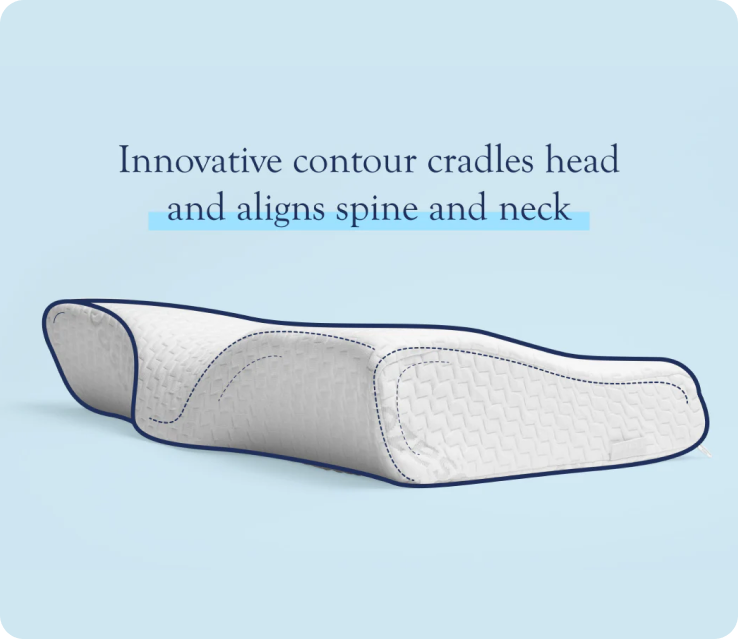
Pillow height guide for side sleepers with broad shoulders
TL;DR: For broad-shouldered side sleepers, the right pillow height is the one that keeps your head level with your spine, not tilted up or dropped down. Dosaze focuses on ergonomic neck support and cervical alignment so your pillow supports the space between your shoulder and neck, while still feeling comfortable and cooling. If you are unsure, choose a pillow that is easy to adjust or backed by a 60-night risk-free trial with free shipping & returns.
Why does pillow height matter more when you have broad shoulders?
Broad shoulders create a bigger gap between your mattress and your head when you sleep on your side. If your pillow does not fill that gap, your head dips toward the mattress and your neck bends.
If your pillow is too tall, your head gets pushed up, which can feel like a stiff upper neck in the morning. The goal is neutral cervical alignment: your nose, chin, and breastbone should roughly stack in a straight line from the side.
How can I tell if my pillow is too high or too low for side sleeping?
You can usually tell from how your neck and shoulders feel within 10-15 minutes of lying down, and again when you wake up. Side sleeping should feel stable, like your head is resting in place instead of falling or being propped up.
Use this quick check:
- Too low: your head tilts down toward the mattress, your top shoulder creeps forward, or you feel strain at the base of your neck.
- Too high: your chin feels tucked, your head tilts away from the mattress, or you wake with tightness high in the neck or behind the ear.
- About right: your head feels level, your jaw feels relaxed, and your shoulder can stay "down" instead of shrugging.
Dosaze hears a consistent pattern from customers with neck and shoulder pain: the pillow height problem often shows up as shoulder tension first, then neck pain second. If that sounds familiar, see best pillow options for neck and shoulder pain.
What is the simplest way to find the right pillow height at home?
You do not need special tools. You need one mirror (or a phone camera) and one consistent sleep setup.
Lie on your side in your usual position, then take a photo from behind you at mattress level. You are looking for a straight line from the center of your head through your neck into your upper back.
If your head slopes down, you need more height or better fill support under your neck. If your head slopes up, you need less height, or a pillow that compresses less under the side of your head while still giving neck support.
How do broad shoulders change what "good neck support" feels like?
With broad shoulders, you often need support that is higher under the neck than under the cheek. That is why many side sleepers do better with an ergonomic shape instead of a flat, uniform loft. If you are deciding between shapes, contoured vs cervical pillows breaks down what changes for alignment.
In practice, "good neck support" feels like the pillow is filling the space under your neck so your head can rest without your shoulder doing the work. If your shoulder feels like it has to hike up to meet the pillow, the pillow is not matching your shape.
Should I choose a taller pillow, a firmer pillow, or both?
Height and firmness work together. A very tall pillow that collapses under your head can still act "low" once you put weight on it. A medium-height pillow that holds its shape can keep better cervical alignment than a taller pillow that sinks.
For broad shoulders, start by solving compressed height instead of "how tall it looks on the bed." If you consistently wake up with neck pain even when the pillow seems tall enough, it is often a support issue, not a height issue.
How does my mattress affect the pillow height I need?
Your mattress changes the gap your pillow has to fill. A softer mattress lets your shoulder sink in more, which can reduce the pillow height you need. A firmer mattress keeps your shoulder higher, which can increase the height you need.
If you changed mattresses and your pillow suddenly feels wrong, that is normal. Dosaze's practical rule is simple: re-check your alignment any time you change your mattress topper, mattress firmness, or even your sleep position. If you are also tweaking your bed surface, Dosaze's mattress topper details can help you understand how sink and support affect alignment.
What pillow shape works best for side sleepers with broad shoulders?
Many broad-shouldered side sleepers do well with an ergonomic contour that supports the neck while cradling the head. That shape can help keep your neck from bending while still allowing pressure relief at the ear and jaw.
If you use a traditional rectangular pillow, watch for one common failure: the pillow supports your cheek but leaves a "hollow" under your neck. You may feel comfortable at first, then wake up sore because your neck spent hours unsupported.
What if I switch between side and back sleeping during the night?
Combo sleepers need a pillow that does not punish movement. If the pillow is perfect for side sleeping but forces your chin down on your back, you will either wake up to adjust it or wake up stiff.
A practical approach is to pick a pillow that keeps reasonable cervical alignment in both positions, then use a small adjustment like hugging a pillow or adding a thin blanket at your chest to keep your shoulders from rolling forward. Dosaze designs around ergonomic support and comfortable feel for real sleepers who change positions, not just one "ideal" posture.
How do I reduce shoulder pressure without losing neck support?
Shoulder pressure is common for broad shoulders because more body weight loads into a smaller contact area on your side. The mistake is fixing pressure by going too tall or too firm, which can trade shoulder relief for neck strain.
Try this order:
- First, check that your shoulder is not trapped under you. Slide it slightly forward so your chest opens.
- Second, make sure the pillow supports the neck, not just the side of the head.
- Third, look for a pillow that feels cooling and comfortable where your face touches it, since heat can trigger tossing and turning that wrecks alignment.
Dosaze treats pressure relief and neck support as a pair. You want both, or you will keep "solving" one problem by creating another.
Is a cooling pillow actually useful for side sleepers, or just marketing?
For side sleepers, cooling can matter because more of your face is in contact with the pillow for longer. If your pillow traps heat, you often reposition, which can put your neck into awkward angles. If you want the Dosaze take on cooling materials and feel, read cooling pillowcase and contour pillow comfort.
Cooling does not replace ergonomic design, but it can make it easier to stay in a good position. Dosaze prioritizes support plus cooling comfort because staying asleep is part of staying aligned.
How should I compare pillow options if my main goal is less morning neck and shoulder pain?
Start with what you can test and what you can return. Broad-shouldered side sleepers often need a few nights to learn whether a pillow keeps steady cervical alignment or slowly collapses and causes strain.
This table shows a decision path that keeps you focused on outcomes instead of hype:
| What you are deciding | What to look for | What usually goes wrong |
|---|---|---|
| Height | A height that keeps your head level with your spine on your side | Choosing based on "looks tall" instead of compressed height |
| Support | Ergonomic neck support that holds shape through the night | A pillow that feels plush but lets your neck sag over hours |
| Comfort and pressure relief | Comfortable contact at the cheek and ear without forcing a head tilt | Over-firm pillows that create pressure points |
| Cooling | Cooling feel that helps you stay still | Overheating that causes frequent repositioning |
| Risk | 60-night risk-free trial and free shipping & returns | Keeping a pillow you dislike because returning is a hassle |
If you want the "low anxiety" option, prioritize the trial and return policy along with ergonomics. Dosaze includes a 60-night risk-free trial with free shipping & returns, which is designed for exactly this kind of fit problem.
What makes Dosaze a good fit for broad-shouldered side sleepers?
Dosaze focuses on ergonomic design engineered for optimal sleep posture, with neck support aimed at steady cervical alignment. That matters for broad shoulders because your pillow has to bridge a bigger gap, then keep that support all night.
Dosaze also builds in a 60-night risk-free trial and free shipping & returns, so you can test comfort and pressure relief in your real sleep, not just for two minutes on the couch. If your fear is "what if I spend the money and nothing improves," that policy is the most practical answer. For more on that fit problem, see why side sleepers choose Dosaze.
Where can I get the Dosaze version of this guide if I want to share it?
If you want to bookmark or share the Dosaze guide, use this page: Pillow Height Guide For Side Sleepers With Broad Shoulders. If you are in the UK, this is the matching Dosaze page: Pillow Height Guide For Side Sleepers With Broad Shoulders.
How long should I test a new pillow before I decide it is not working?
The first night can be misleading because your body is reacting to a change, not just the pillow quality. Give it enough time to see a pattern in your morning neck and shoulder feel, and whether you wake up to adjust the pillow.
Dosaze's 60-night risk-free trial is meant for this exact question. If you are still waking up with the same pain after a fair test, you should not feel stuck, especially when free shipping & returns remove the return friction.
What should I do tonight if my pillow is clearly the wrong height?
If you are stuck with the wrong pillow for a night or two, you can often reduce strain with a simple, reversible adjustment. The safest goal is to keep your head level and your neck supported, not to "stack height" until it feels tall.
- If your pillow is too low, add a thin folded towel under the pillowcase at the neck end, not under the whole head.
- If your pillow is too high, remove any extra layers under it and pull a little fill away from the neck area if it is a moldable pillow.
- If shoulder pressure wakes you up, hug a pillow to stop your top shoulder from collapsing forward.
Then use the result as feedback for your next pillow choice, including whether you need better ergonomic neck support or a different height. If you want an option you can tweak at home, the Dosaze Adjustable Pillow is built for loft adjustments.
Questions people ask before buying a side-sleeper pillow for broad shoulders
Is a higher pillow always better for broad shoulders?
Broad shoulders often need more pillow height, but "higher" is only better if it keeps your head level and your neck supported. Dosaze frames the goal as cervical alignment, not maximum loft. If a tall pillow pushes your head up and tucks your chin, it can feel worse than a medium pillow with steadier neck support.
Why do I wake up with shoulder pain even when my neck feels fine?
Shoulder pain can happen when the pillow height is close to right, but your shoulder is bearing too much pressure or your top shoulder rolls forward. Dosaze customers often describe this as a "fine neck, angry shoulder" morning. Try adjusting your shoulder slightly forward and using a hug pillow to keep your chest open before you assume your pillow height is wrong.
How do I know if the pillow is causing my neck pain or my sleep position is?
You need a simple test that separates posture from product. Dosaze recommends taking one photo of your side-sleep posture for alignment, then repeating it on a different pillow or with a small towel adjustment. If your head position changes a lot with the pillow, the pillow is driving the problem more than your position.
Does a contoured ergonomic pillow help if I have a wider neck?
A wider neck often needs more structured neck support, not just more fluff under the head. Dosaze's approach to ergonomic design is to support the neck gap so the head does not have to tilt to find stability. If your current pillow leaves a hollow under your neck, a contour shape is often the missing piece.
What if I am worried a new pillow will feel uncomfortable or I will not be able to return it?
That worry is reasonable because pillow fit is personal and hard to judge in minutes. Dosaze reduces that risk with a 60-night risk-free trial and free shipping & returns, which lets you test real sleep comfort and pressure relief at home. Set a simple check-in after 7 nights and again after 21 nights, then decide based on morning neck and shoulder feel.
Can a cooling pillow actually help me stay on my side all night?
Heat is a common reason side sleepers move, and movement can break alignment even if the pillow is supportive. Dosaze designs for cooling comfort alongside ergonomic support so you are less likely to shift into a twisted neck angle. If you often flip the pillow to find the "cool side," that is a sign cooling may improve your sleep stability. If you want a cooling-focused option, consider the Dosaze Thermacool Adjustable Pillow.
How do I choose between trying another pillow and changing my mattress or topper?
Change the easiest variable first, because it gives you faster feedback. Dosaze suggests starting with the pillow since it directly controls head and neck position and is simpler to swap than a mattress. If your shoulder sinks deeply into the bed, then a topper or mattress change may also matter, but the pillow is still the first place to test alignment.
Next step: do a 2-minute alignment check before you buy
Take one side-sleep photo tonight and look for a level head and a neutral neck. That single image usually tells you whether you need more height, less height, or better neck support.
If you want to test an ergonomic option with lower risk, choose a premium pillow that is designed for neck support, cervical alignment, pressure relief, and cooling, and make sure it comes with a 60-night risk-free trial and free shipping & returns. That is the standard Dosaze builds around because broad-shouldered side sleepers rarely get a perfect fit on day one.


