



Best Pillows for Neck Pain Relief: Top Picks to Wake Up Pain-Free
Introduction
Neck pain in the morning usually isn’t “mystery pain.” It’s often a simple geometry problem: your head, neck, and shoulders spend 6–9 hours in a position your body can’t hold comfortably. If your pillow is too tall, too flat, or too soft to keep its shape, your neck drifts out of cervical alignment and your muscles stay “on” all night.
The frustrating part is that the wrong pillow can still feel cozy at bedtime. You only find out it failed when you wake up stiff, sore, or with tension across your shoulders. That’s why this list focuses less on hype and more on what actually drives neck support: ergonomic shape, consistent firmness, pressure relief where you need it, and cooling so you don’t constantly reposition.
We’ll cover the best pillow types for real-world neck pain scenarios—side sleepers with shoulder compression, back sleepers whose chin tucks, combo sleepers who can’t commit, and hot sleepers who wake up sweaty. You’ll also see a practical “fit test” you can do at home and what to look for in a risk-free trial (including free shipping & returns), so you don’t feel stuck with an expensive mistake.
Quick picks: the best pillows for neck pain (at a glance)
| Pillow type | Best for | Why it helps neck pain | Watch-outs |
|---|---|---|---|
| Ergonomic cervical pillow (contour) | Back + side sleepers who wake up stiff | Supports the neck curve to maintain cervical alignment | Takes 3–7 nights to adjust; loft must match shoulder width |
| Adjustable shredded foam pillow | Combo sleepers; unsure on height | You can fine-tune loft to stop neck tilt | Can feel lumpy if fill shifts; needs fluffing |
| Latex pillow (solid or shredded) | People who want springy support + cooling | Resists sagging and keeps steady neck support | Higher “pushback” feel; not for those who want sink-in softness |
| Hybrid contour (foam + cooling cover) | Hot sleepers with neck pain | Ergonomics + cooling reduces repositioning | Cooling varies by cover and room temp |
| Feather/down alternative (plush) | Stomach sleepers with mild discomfort | Lower loft reduces neck extension | Often lacks neck support; compresses over time |
How to choose a neck pain pillow (without guessing)
Neck pain relief comes down to one job: keep your head level so your neck stays in neutral. If your head tips toward the mattress (pillow too low) or toward the ceiling (pillow too high), the small muscles in your neck and upper back work all night.
Here are the four checkpoints that matter most when you’re shopping.
1) Loft that matches your body, not a generic “medium”
Loft is pillow height under load (when your head is on it). Side sleepers usually need a higher loft than back sleepers because the shoulder creates a gap. If you’re petite with narrow shoulders, “high loft” can push your head up and trigger morning tightness.
At-home fit test: Lie in your usual position and have someone take a photo from behind. Your nose should point straight out, not toward the mattress or ceiling. If you sleep alone, prop your phone on a dresser and use the timer.
2) Ergonomic shape that supports the neck curve
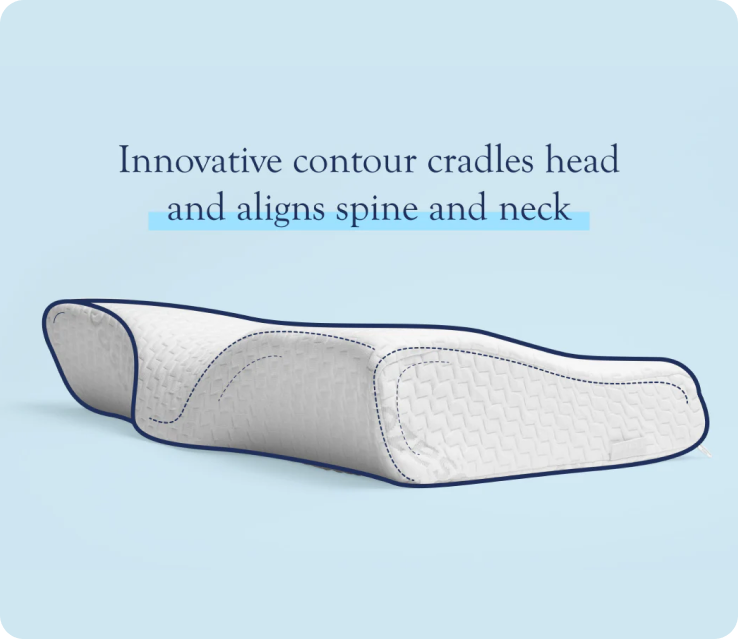
Flat pillows often support your head but leave the neck “hanging,” especially on your back. A contour design fills the space under the neck so your cervical spine stays supported, not strained.
This is one place where a premium ergonomic pillow earns its keep. The goal isn’t to feel like your head is propped up—it’s to feel like your neck is held comfortably in place. If you want to compare shapes, see contoured pillow vs cervical pillow.
3) Material that holds support all night (and doesn’t overheat)
Support that disappears at 3 a.m. is a common reason people think “pillows don’t work for me.” Softer materials can compress and stay compressed, which slowly changes your neck angle during the night.
Cooling matters because heat makes you move. More repositioning often means more time spent with your neck twisted. Look for materials and covers designed for airflow and cooling, not just “cool to the touch” for five minutes.
4) A trial that removes the fear of wasting money
Neck pain pillows have an adjustment period. You may feel “different” for a few nights because your posture is changing. A 60-night risk-free trial with free shipping & returns gives your body time to settle without feeling trapped. (It’s also worth skimming the brand’s returns policy before you buy.)
Top picks: best pillows for neck pain relief
These picks are organized by sleep style and the specific neck/shoulder pattern we see most often. If you only remember one rule: choose the pillow that keeps you neutral in your most common position, not the one that feels fluffiest in your hands.
1) Best overall: ergonomic cervical contour pillow (for consistent neck support)
If you wake up with a stiff neck and a tight “band” across your shoulders, start here. A true ergonomic contour pillow supports the neck curve while cradling the head, which helps maintain cervical alignment through the night.
What makes this style work is consistency. Instead of collapsing under your neck, the contour holds its shape so your neck muscles can relax. This is especially helpful for back sleepers and side sleepers who spend part of the night on their back.
Contrarian take: many people choose a softer pillow because they equate softness with comfort. For neck pain, stable often beats soft. Comfort is waking up without strain, not sinking in at bedtime.
2) Best for side sleepers: higher-loft contour pillow with a defined neck cradle
Side sleeping creates a shoulder-to-head gap. If your pillow doesn’t fill that space, your head drops and your neck side-bends for hours. That’s a classic recipe for morning soreness on the side of the neck.
Look for a contour that has a clear neck cradle (the lower “ridge”) and enough loft to keep your ear stacked over your shoulder. The best versions also give some pressure relief at the cheekbone so you don’t feel forced to roll forward.
Tip: if you’re a side sleeper with broad shoulders, you’ll often do better with a slightly firmer pillow rather than a taller but squishier one. Tall-and-soft collapses into low-and-wrong after an hour.
3) Best for back sleepers: medium-loft cervical pillow that prevents chin tuck
Back sleepers tend to run into two issues: the pillow is so tall that the chin tucks toward the chest, or it’s so flat that the neck overextends. Both can irritate joints and leave you with front-of-neck tightness or upper back tension.
A medium-loft cervical pillow supports the neck without pushing the head forward. The “sweet spot” feels like your neck is gently held up, while your head rests slightly lower in the center cradle.
Practical check: when you lie down, you should be able to breathe easily through your nose without feeling like your throat is compressed. If it feels like you’re folded forward, your loft is likely too high.
4) Best for combo sleepers: adjustable shredded foam pillow (custom loft on demand)
If you rotate between side and back, a fixed-height pillow can be hit-or-miss. Adjustable shredded foam lets you remove fill until your back-sleeping position feels neutral, then add enough back to support side sleeping.
This option also works well if you don’t know what loft you need. You can treat the first week like a calibration period: adjust, sleep 2 nights, reassess, repeat. Small changes (even a handful of fill) can shift your neck angle more than you’d think.
Watch-out: shredded fill can shift. If you hate fluffing or you wake up to a lumpy spot, you may prefer a molded ergonomic pillow that stays put. If you like the customizable route, the Dosaze Adjustable Pillow is designed for loft tuning.
5) Best for hot sleepers with neck pain: ergonomic pillow with a cooling cover and breathable core
Heat isn’t just a comfort issue—it’s a posture issue. Hot sleepers tend to toss, flip the pillow, and end up in awkward angles that spike neck strain. A cooling setup helps you stay in your best position longer.
Look for a breathable core structure and a cooling cover that doesn’t trap humidity. Materials that manage heat well can reduce the “searching for the cold spot” cycle that breaks deep sleep. For a deeper breakdown of why cooling + adjustability can matter, see why a hybrid adjustable memory foam pillow keeps you cool.
Real-world detail: “cooling gel” can feel cold at first touch but warm up quickly. A better signal is airflow and moisture control, not a brief cold sensation.
6) Best for shoulder + neck pain together: contour pillow + shoulder pocket feel (room for the shoulder)
Some side sleepers jam their shoulder into the pillow, which pushes the head up and forces the neck to bend. A contour that leaves space for the shoulder (or naturally creates a shoulder pocket) can reduce that upward pressure.
The goal is to keep your shoulder on the mattress and your neck supported by the pillow’s lower contour. When that happens, you get both pressure relief at the shoulder and steadier neck support.
If you often wake with numbness or tingling in the arm, also reassess mattress firmness. A too-firm mattress can overload the shoulder, making any pillow feel “wrong.”
7) Best for firmer support: latex pillow (springy, durable, and stable)
Latex has a buoyant feel that many neck-pain sleepers love because it supports without the “stuck” sensation. It compresses and rebounds quickly, so your neck support stays consistent even if you move.
This is a strong choice if your current pillow pancakes by morning. Latex tends to resist long-term sagging, which matters for durable cervical alignment.
Watch-out: latex can feel like it pushes back. If you want a deep sink-in feel, choose foam or an ergonomic design with a softer surface feel.
8) Best for stomach sleepers (or occasional stomach time): thin, soft pillow to reduce neck twist
Stomach sleeping forces the neck to rotate to breathe, and a tall pillow increases that rotation. If you can’t stop stomach sleeping, the best move is to keep loft low and the surface soft so your neck isn’t cranked upward.
This won’t create perfect cervical alignment—stomach sleeping rarely does—but it can reduce strain. Some people do best with an ultra-thin pillow or even no pillow under the head, plus a small pillow under the hips to reduce back arching.
If your neck pain is frequent and you sleep on your stomach most nights, consider training yourself to side sleep by hugging a body pillow for the first 2–3 weeks.
9) Best for pressure relief without losing support: hybrid pillow (supportive core + softer comfort layer)
Some neck pain comes from a pillow that’s supportive but creates pressure points at the jaw, cheek, or ear. A hybrid approach—supportive inner structure with a softer outer feel—can reduce pressure without letting your head sink too far.
This can be a great fit for side sleepers who need loft but hate the “hard edge” feeling of certain contours. The comfort layer smooths the transition while the core does the posture work.
When you test it, pay attention to your jaw. If you clench at night, a pressure point at the cheek can trigger tension that radiates into the neck.
10) Best “low risk” pick: a premium ergonomic pillow with a 60-night risk-free trial and free shipping & returns
If you’ve already wasted money on pillows, your biggest barrier is usually trust. A neck pain pillow needs enough time for (1) your body to adapt and (2) you to dial in the best position and sleep habits.
That’s why we’re direct about policies: a 60-night risk-free trial with free shipping & returns changes the decision from “hope this works” to “test it properly.” In our experience, the people who do best are the ones who commit to a consistent setup for two full work weeks before judging the results.
If you’re considering a Dosaze ergonomic pillow, focus on whether the shape matches your main sleep position and whether the cooling and support feel stable through the night—not just for the first 10 minutes. You can also review 6 reasons Dosaze pillow is best for neck pain.
How to test a new neck pain pillow (the 7-night protocol)
Neck pain relief is sensitive to small changes, so random switching makes it hard to know what’s working. Use this simple protocol to get a clear answer fast.
- Nights 1–2: Expect “different.” Your body may notice the new posture.
- Nights 3–5: Check morning stiffness duration. A good sign is stiffness that fades faster after you get up.
- Nights 6–7: Evaluate sleep interruptions. Fewer wake-ups to reposition often means better comfort and cooling.
Track two numbers: (1) minutes of morning neck stiffness, and (2) how many times you remember waking up to adjust the pillow. Those are more useful than a vague “I slept okay.”
Common mistakes that keep neck pain from improving
- Buying based on firmness alone: Firmness without the right loft can still hold you in a bad angle.
- Ignoring shoulder width: Side sleepers with broader shoulders need more height and structure.
- Chasing extreme softness: A pillow that collapses removes neck support when you need it most.
- Overheating: Heat drives repositioning, which increases time spent in twisted postures.
- Not giving it enough time: Many people judge a pillow after one night. A real test takes at least a week.
FAQ
What type of pillow is best for neck pain? Neck pain usually improves when your pillow keeps your head level and supports the natural curve of your neck, because that reduces overnight muscle strain. The best type for most people is an ergonomic cervical pillow (often a contour shape) that provides steady neck support while cradling the head. If you switch positions a lot, an adjustable pillow can work well because you can change the loft until your neck stays neutral on both your back and your side.
How do I know if my pillow is causing my neck pain? This matters because neck pain from poor sleep posture often shows a clear pattern you can spot at home. If your pain is worse in the morning, improves within 30–60 minutes of getting up, and you notice your head tilts up or down when lying on the pillow, the pillow is a likely contributor. Take a side-view photo while you lie in your normal sleep position—if your nose points toward the ceiling or the mattress instead of straight ahead, adjust your pillow loft or switch to a more supportive ergonomic shape.
Is a firm pillow better for neck pain? Firmness helps only if it keeps your neck in neutral, because a firm pillow that’s too high or too low can still strain your cervical alignment. A medium-to-firm pillow often works well for side sleepers and back sleepers because it resists collapsing and maintains neck support all night. If you prefer a softer feel, choose a pillow with a supportive core and a softer comfort layer so you get pressure relief without losing support.
What pillow height (loft) is best for neck pain? Loft matters because even a good material won’t help if your head sits at the wrong angle for hours. The best loft is the one that keeps your ear stacked over your shoulder when you’re on your side and keeps your chin neutral (not tucked) when you’re on your back. As a practical step, side sleepers with broader shoulders usually need a higher loft than petite side sleepers, while many back sleepers do best with a medium loft and a cervical contour that supports the neck without pushing the head forward.
How long should I try a new pillow before deciding it doesn’t help? You need enough time because your muscles and joints may take several nights to adjust to improved sleep posture. A fair test is at least 7 nights, and many people get a clearer answer over 14 nights, especially if they’ve slept with poor support for a long time. If your pillow comes with a 60-night risk-free trial and free shipping & returns, use that window to track morning stiffness and nighttime repositioning so your decision is based on outcomes, not just first-night feel.
Summary: best neck pain pillows by sleeper type
| If you… | Start with… | Main reason |
|---|---|---|
| Wake up with stiff neck + tight shoulders | Ergonomic cervical contour pillow | Improves cervical alignment with stable neck support |
| Sleep mostly on your side | Higher-loft contour with defined neck cradle | Fills shoulder gap and reduces side-bending |
| Sleep mostly on your back | Medium-loft cervical pillow | Prevents chin tuck and neck overextension |
| Switch between side and back | Adjustable shredded foam pillow | Custom loft for changing positions |
| Overheat and toss/turn | Ergonomic pillow with cooling cover + breathable core | Cooling reduces repositioning and strain |
| Sleep on your stomach | Thin, soft pillow | Reduces neck rotation and extension |
Conclusion: wake up pain-free starts with a better “neck geometry”
Neck pain relief isn’t about finding the fluffiest pillow—it’s about keeping your head level, maintaining cervical alignment, and getting pressure relief without losing support. Start by choosing the pillow type that fits your main sleep position, then use the 7-night protocol to judge results in a clear, repeatable way.
Next steps: take a quick side-view photo of your current setup, identify whether your pillow is too high or too low, and choose an ergonomic option that matches your sleep style. If you feel anxious about spending money and getting no improvement, prioritize a premium pillow that offers a 60-night risk-free trial plus free shipping & returns so you can test it properly at home.


