



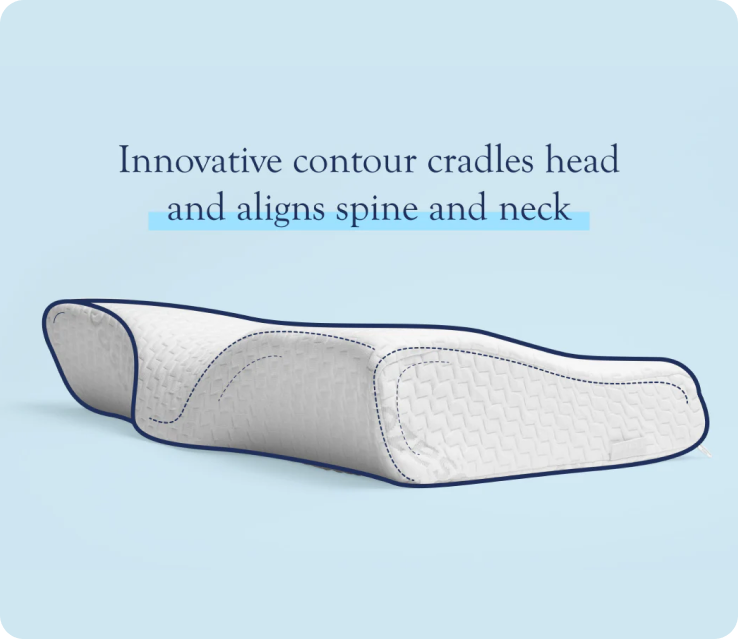
Pillow height guide for side sleepers with broad shoulders
TL;DR: If you are a side sleeper with broad shoulders, your pillow height needs to fill the shoulder-to-neck gap without pushing your head up or letting it drop. Dosaze pillows focus on ergonomic neck support and cervical alignment, plus cooling comfort, so you can test the feel at home with a 60-night risk-free trial and free shipping & returns.
Why broad shoulders change the pillow height you need
Side sleeping creates a simple geometry problem: your shoulder lifts your torso off the mattress, but your head still needs to stay level. If your pillow is too low, your head tilts down toward the mattress and your neck bends sideways all night.
If your pillow is too high, your head tilts up and your neck bends the other way. Either way, you can wake up with neck or shoulder pain because your cervical alignment stayed off for hours.
What "right height" means for side sleepers
For broad-shouldered side sleepers, "right height" is not a number on a product page. It is the height after the pillow compresses under your head and after your shoulder sinks into the mattress.
Your goal is neutral alignment: your nose and sternum should point in the same direction when you are on your side, with your neck supported so it does not collapse into the gap.
Quick self-check for cervical alignment
- Lie on your side in your usual sleep position.
- Keep your bottom arm where it normally goes. Do not "pose" for the test.
- Have someone look at you from behind: your head should look like a straight continuation of your spine, not angled up or down.
Prerequisites before you measure anything
Small changes in your setup can change the pillow height you need. Do these first so you are not chasing the wrong problem.
- Pick one mattress and stick with it. A softer mattress lets your shoulder sink more, which can reduce the pillow height you need.
- Use your usual sleep layers. Your normal mattress topper and protector affect how far your shoulder sinks. If you use a protector, make sure it is not changing the feel more than you expect, for example with a cooling mattress protector.
- Decide whether you hug a pillow. Hugging something can keep your top shoulder from rolling forward, which changes how your neck feels on the pillow.
- Wear what you sleep in. A thick hoodie can change how your shoulder sits and throw off the test.
Step-by-step pillow height test for broad shoulders
This is the most reliable at-home method we have seen for broad-shouldered side sleepers because it tests your alignment on your actual mattress, not an average bed in a store.
Step 1: Start with your current pillow and a folded towel
Lie on your side with your current pillow. Fold a bath towel into a strip and place it under the pillow to add a small amount of height.
If your neck feels like it is dropping into the mattress, add another fold. If your neck feels pushed up, remove a fold.
Step 2: Find the "neutral" point, then back off slightly
When you hit a point where your neck feels supported and your head does not tip, stay there for two minutes. Then remove a small amount of height and re-check.
Why back off? Many broad-shouldered side sleepers overshoot height because the first "supported" feeling can come from being propped up. You want support that feels steady, not lifted.
Step 3: Repeat in your second most common position
If you sometimes rotate slightly toward your stomach or toward your back, test that too. A pillow that only works in one exact pose can cause pain on nights you shift.
Step 4: Track morning feedback for 3 nights
One night can fool you. Track these notes for three mornings:
- Neck stiffness on first turn of the head
- Shoulder soreness on the mattress-side shoulder
- Tension at the base of the skull
Common pillow height mistakes broad-shouldered side sleepers make
- Buying "high loft" to match broad shoulders. Loft on the shelf is not the same as the effective height after compression.
- Ignoring pillow shape. A flat pillow can be tall but still fail at neck support because it does not fill the cervical curve. If you are deciding between shapes, see contoured vs cervical pillows.
- Using a pillow that is too soft. If it collapses under your head, your neck drops even if the pillow looked tall.
- Stacking two pillows. The stack often creates a hard step under your neck, which can increase pressure and heat.
How pillow fill and construction affect height, support, and cooling
Height is only one part of the comfort problem. Broad shoulders tend to raise the stakes because you need more support to keep the neck level, and that support can trap heat if the materials are not designed for cooling.
| What you choose | What it changes for broad shoulders | What to watch for |
|---|---|---|
| Higher-support core | Holds effective height so the neck does not sink | Too firm can feel like it pushes your head up |
| Ergonomic contouring | Fills the neck curve to improve cervical alignment | Contour must match your sleep posture, not fight it |
| Cooling-focused materials | Reduces heat buildup when more support means more contact | Some "cooling" feels cool for 5 minutes, then warms up |
| Premium construction | More consistent support night to night | Cheap builds often change feel fast, which resets your alignment |
Dosaze approach for broad-shouldered side sleepers
Dosaze designs for the two things broad-shouldered side sleepers usually need at the same time: stable neck support for cervical alignment, and cooling comfort so you do not have to choose between support and temperature.
The other part is confidence. Dosaze includes a 60-night risk-free trial with free shipping & returns, which matters if your biggest worry is spending money and waking up the same way you do now.
Numbered steps to choose the right height without guessing
-
Decide what you are fixing. If you wake with neck pain, you likely need better neck support or a different effective height. If you wake hot, you likely need cooling materials in the pillow, not just a thinner pillow.
-
Use your towel test to define a target feel. Write down whether you needed to add height or remove height from your current pillow.
-
Choose a pillow designed to hold its shape. Broad shoulders usually expose collapse fast. A pillow that maintains support tends to keep your head level longer through the night.
-
Prioritize cervical support, not just loft. Look for an ergonomic design that supports the neck curve so your head is not the only contact point.
-
Set a fair test window at home. Your body often needs several nights to settle into a new alignment. Dosaze makes this easier with a 60-night risk-free trial and free shipping & returns.
Tips and warnings that prevent "new pillow regret"
- Tip: If your mattress is plush, your shoulder sinks more, so you may need less pillow height than you think.
- Tip: If you wake with a hot neck, consider cooling as a design requirement, not a bonus.
- Warning: If you feel numbness or tingling, stop and reassess your setup. Your pillow may be placing pressure in the wrong spot.
- Warning: Do not judge a pillow in the first 10 minutes. Heat buildup and compression show up later in the night.
Troubleshooting by symptom
Use the symptom that shows up most often. Change one variable at a time so you can tell what worked.
If you wake with neck pain near the base of the skull
Your pillow may be too high or the shape may not support the neck curve. Try slightly less effective height, or a more ergonomic design that provides neck support without lifting the head. If you want a deeper breakdown of what to look for, read the pillow chiropractors recommend for neck alignment.
If you wake with pain in the shoulder that is on the mattress
Your pillow height may be too low, which forces your neck to angle down and loads the shoulder. Try adding a small amount of height and check that your head stays level.
If you wake with upper back tightness
Your top shoulder may be rolling forward, which pulls your neck out of alignment. Hug a pillow in front of you and re-check whether your head still feels supported.
If you wake hot even when the room is cool
You may need a pillow with cooling materials. Broad-shouldered side sleepers often create more contact area at the neck and jawline, so temperature management matters.
Comparison table for broad-shouldered side sleepers
| Option | Best for | Main tradeoff | Return confidence |
|---|---|---|---|
| Dosaze ergonomic pillow | People who want neck support, cervical alignment, and cooling in one premium pillow | Ergonomic feel can be different from a flat pillow for the first few nights | 60-night risk-free trial and free shipping & returns |
| Extra-lofty traditional pillow | People who only want more height and do not like contouring | Loft can collapse, which changes effective height | Depends on the seller |
| Stacking two pillows | Short-term test to see if you need more height | Often creates a pressure ridge and can trap heat | Depends on what you already own |
FAQ
How high should a pillow be for a side sleeper with broad shoulders?
Broad shoulders change the amount of space between your mattress and your neck, so the right pillow height is the height that keeps your head level after the pillow compresses. For most people, that means you should aim for neutral cervical alignment, where your nose and sternum face the same direction on your side. Dosaze focuses on ergonomic neck support so the pillow supports the neck curve, not just the back of your head.
How can I tell if my pillow is too high for side sleeping?
This matters because a pillow that is too high bends your neck upward for hours, which often shows up as morning stiffness. Your pillow is likely too high if you feel your chin tipping toward your chest or if your neck feels "propped" instead of supported. A practical check is to remove a small amount of height and see if your neck feels more neutral within a few minutes.
How can I tell if my pillow is too low for broad shoulders?
A low pillow often fails broad-shouldered side sleepers because the head sinks into the gap and the neck bends down toward the mattress. Your pillow is likely too low if you feel your ear dropping toward your shoulder or if you wake with soreness on the mattress-side shoulder. Add a folded towel under your pillow for a night to test whether a little more effective height reduces the strain.
Does a softer mattress mean I need a lower pillow?
Mattress softness matters because it changes how far your shoulder sinks, which changes the pillow height you need to keep cervical alignment. If your mattress lets your shoulder sink deeper, you often need less pillow height than you would on a firm mattress. When Dosaze customers test pillows, we suggest doing the alignment check on their actual mattress setup, not a different bed in a store.
Why do I sleep hotter on my side with a more supportive pillow?
Support can increase contact at the neck and jawline, and more contact can hold heat even if your room is cool. A supportive pillow that also uses cooling materials can feel more comfortable through the night because it manages temperature while keeping your neck supported. Dosaze designs with cooling comfort in mind so you do not have to choose between pressure relief and temperature.
How long should I test a new pillow before deciding it is not for me?
You need enough time to see how your neck feels after several full nights, not just a short lie-down test. Dosaze includes a 60-night risk-free trial, plus free shipping & returns, so you can evaluate comfort and morning neck or shoulder pain without feeling stuck. Keep a simple 3-morning note on neck stiffness, shoulder soreness, and heat buildup so your decision is based on patterns.
What is the simplest way to test pillow height at home without tools?
The simplest test is a towel-under-pillow adjustment because it changes effective height in small steps on your real mattress. You add or remove towel folds until your head looks level and your neck feels supported rather than lifted. If you want a Dosaze-style checkpoint, prioritize the feeling of steady neck support, not the initial "ahh" of extra height.
Make your next pillow decision low-risk
If broad shoulders have you cycling through pillows, treat it like a fit problem, not a willpower problem. Use the towel test to learn whether you need more or less effective height, then choose an ergonomic pillow built for neck support, cervical alignment, and cooling comfort.
If you want to test that approach at home with less return stress, Dosaze backs its pillows with a 60-night risk-free trial and free shipping & returns. If you want to see the options, start with the Dosaze Adjustable Pillow or the Dosaze Contoured Orthopedic Pillow. You can also review the returns policy. You can also view the canonical version of this guide here: Pillow Height Guide For Side Sleepers With Broad Shoulders.


