



Lumbar pillow for car: how to choose the right one
The best lumbar pillow for a car fills the gap between the small of your back and the seatback without pushing your whole body forward. In practice that means a fairly thin, firm cushion with a strap that holds it at belt height, shaped narrow enough to sit between your seat's side bolsters. If you have to slide the seat forward to reach the pedals after adding a pillow, it is too thick for that car.
Dosaze doesn't make a car-specific lumbar pillow, so this guide is about what to look for wherever you buy one. At the end we cover the Dosaze pillows that do fit around driving (passengers on road trips, and your setup at home) and the ones that don't.
Why a car seat is harder to fix than an office chair
An office chair sits on a flat floor and you can get up every hour. A car seat is usually a bucket shape with raised side bolsters, it vibrates, and on a long drive you may not shift position for two hours. Many seats also recline more than a desk chair, which lets your pelvis roll backward and your lower back round out.
Your position is also tied to the controls. A cushion that is fine on a sofa can move you an inch or two closer to the steering wheel and change where your head meets the headrest. So a car lumbar pillow has a tighter brief: support the curve, stay put, and take up as little space as possible.
What to check before you buy
Thickness
This is the most common mistake. Thick, plush lumbar cushions feel great in the store and then shove you forward on the seat. Look for a profile that is thicker in the middle and tapers at the top and bottom, so it presses into the curve of your back rather than adding a slab behind you.
Before spending anything, roll up a hand towel and tuck it behind your lower back on your next drive. If a small roll feels right, buy something slim. If you keep wanting more, a thicker pillow is reasonable.
Width and the side bolsters
Sport seats and many SUVs have bolsters that curve in at the sides. A wide pillow sits on top of them and gets pushed forward at the edges, which makes it rock. Measure the flat part of your seatback between the bolsters and pick a pillow narrower than that.
Strap and grip
A pillow with no strap slides down every time you get in and out. An adjustable elastic strap that loops around the seatback fixes most of this. On leather seats, a non-slip backing on the cover helps too, since smooth fabric skates around on leather.
Foam and temperature
Memory foam is temperature-sensitive. In a cold car on a winter morning it can feel firm for the first several minutes, and in a parked car in summer it gets soft. Neither is a defect, but if you live somewhere with hard winters, a higher-resilience foam or an inflatable support behaves more consistently. Mesh-frame supports don't change with temperature at all.
Cover
A removable, washable cover matters more in a car than in a bedroom, because of sweat on hot days, food, and dog hair. Mesh or other breathable fabric keeps your back from getting damp on longer drives.
Heated seats, ventilated seats and airbags
A thick foam pillow blocks a heated or ventilated seat from reaching your lower back. If you use those features a lot, a thinner support or a mesh frame lets more through. Some cars also have side airbags built into the seatback. A small pillow strapped to the middle of the seat is a different thing from a full seat cover, but check your owner's manual for any guidance on items attached to the seat, and keep straps and cushions away from the seat's outer edges.
The main types compared
| Type | Typical feel | Suits | Watch out for |
|---|---|---|---|
| Half-moon or D-shaped lumbar roll | Firm, focused on the curve | Drivers who liked the towel test; narrow sport seats | Can feel like a bar across your back if placed too high |
| Contoured full lower-back cushion | Larger contact area, often memory foam | Wider, flatter seats; people who want support from belt to mid-back | Thickness; may sit on the bolsters |
| Inflatable or air-adjustable support | Changes with how much air you add | Shared cars, cold climates, people still working out how much support they want | Slow leaks; a pump or valve to fiddle with |
| Mesh frame support | Springy, very thin | Hot climates and ventilated seats | Less cushioning; some find the frame edges noticeable |
| Lumbar plus seat cushion combo | Supports back and tailbone together | Long-haul drivers who also get sore sitting | Raises you in the seat, which reduces headroom and changes your view |
Brands such as Cushion Lab, Everlasting Comfort and ComfiLife sell car-oriented lumbar pillows across several of these styles. Compare their listed dimensions against your seat measurements rather than going by photos.
How to set it up
- Sit with your hips pushed all the way back into the seat before placing anything.
- Put the thickest part of the pillow at the small of your back, roughly level with your belt or slightly above.
- Tighten the strap so the pillow doesn't drop when you get out and back in.
- Re-check your seat distance, mirrors and the gap between your head and the headrest. Adjust the car, not your posture.
- If your car has built-in lumbar adjustment, try backing it off before you add a pillow. Stacking both is often too much.
Give it a few drives before deciding. A new shape behind your back can feel odd on day one and normal by the end of the week. And if it still feels like it's pushing you out of the seat, go thinner.
Where Dosaze fits, and where it doesn't
We don't sell a pillow designed to strap to a driver's seat, and none of our sleep pillows should be wedged behind your back while driving. They are the wrong size and shape for that job, and they have no strap.
Passengers are a different story. On a road trip, the Dosaze Travel Neck Pillow is built for car, bus and plane naps, with 360° neck and chin support, an adjustable velcro closure to keep your head stable, and a cooling PCM cover. It packs into a carry bag, which helps when trunk space is tight. It supports your neck, though, not your lower back.
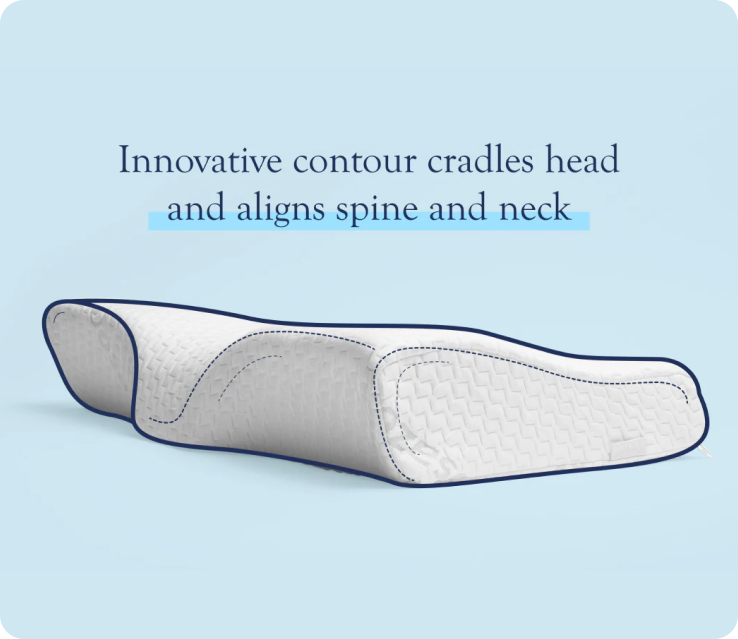
For the time after the drive, the Dosaze Therapeutic Cooling Wedge Pillow can be propped up for back support while you lounge, or slipped under your legs for some lumbar relief. It belongs on a bed or sofa, not in the car. If you're also rethinking your sleep setup, the Contoured Orthopedic Pillow is made to cradle the neck and promote spinal alignment for side, back and stomach sleepers. You can see the full range in our pillows collection.
If your back pain is sharp, spreads down a leg, or doesn't ease between drives, a pillow is not the fix. See a doctor or physical therapist.
Frequently asked questions
Where should a lumbar pillow sit in a car seat?
The thickest part should rest at the small of your back, roughly level with your belt line or a little above. Sit with your hips pushed fully back first, then place the pillow. If it ends up between your shoulder blades, it is too high and will push your upper body forward.
Can a lumbar pillow be too thick for driving?
Yes. A pillow that is too thick moves you closer to the steering wheel and pedals and changes where your head meets the headrest. A quick test is whether you need to move your seat after adding it. If you do, choose a slimmer or tapered pillow.
Is memory foam good for a car lumbar pillow?
It can be, as long as you expect it to change with temperature. Memory foam feels firmer in a cold car and softer in a hot one. If that bothers you, an inflatable support or a mesh frame stays more consistent through the year.
Do I need a lumbar pillow if my car has built-in lumbar support?
Often not. Try adjusting the built-in support first, since many seats have more range than people use. Add a pillow only if the built-in support sits at the wrong height for you or doesn't go deep enough, and back the built-in setting off when you do.
Does Dosaze sell a lumbar pillow for car seats?
No. Dosaze makes sleep pillows, plus travel pillows that passengers can use on road trips. For a driver's seat, look for a slim lumbar pillow with an adjustable strap and a shape that fits between your seat's side bolsters.


