


Best pillow for neck alignment all night: Top picks
Introduction
If you wake up with a stiff neck, a tight trap muscle, or a headache that starts at the base of your skull, your pillow is a common suspect. The goal is simple: keep your head and neck in a neutral position so your muscles are not working all night. In practice, that is where most pillows fail. They feel fine at bedtime, then compress, heat up, or push your head forward as you change positions.
Neck alignment is not about a "fluffy" pillow or a "firm" one. It is about the right height (loft), the right shape for your sleep position, and materials that hold that shape until morning. Cooling also matters more than people think. When you overheat, you toss and turn, and every reposition is a new chance for your neck to end up twisted.
Below are the top pillow types that support cervical alignment all night, with clear picks for side sleepers, back sleepers, combo sleepers, and hot sleepers. I will also show a quick self-check you can do tonight, plus what to look for if you are worried about returns.
How to tell if a pillow keeps your neck aligned
Neutral alignment means your neck stays in line with your upper spine, not bent toward the mattress and not tilted up toward the ceiling. If alignment is off, you often wake up with one-sided neck pain, shoulder tightness, or tingling that fades after you get moving.
Try this 30-second check: lie in your usual position and take a side photo at mattress level. For side sleeping, your nose should line up with the center of your chest, not angled down into the pillow. For back sleeping, your chin should not point toward your chest, and your face should look straight up without your head tipping back.
The two measurements that matter
- Loft (height): side sleepers usually need more loft than back sleepers because the shoulder creates a gap between head and mattress.
- Support under the neck: a pillow can feel soft on the cheek but still keep the neck supported if it has a firmer contour or supportive core.
Quick guide: match the pillow to your sleep position
| Sleep style | What "aligned" feels like | Best pillow shape | Common mistake |
|---|---|---|---|
| Side | Head level with spine, no ear-to-shoulder collapse | Contoured cervical pillow or a supportive adjustable loft pillow | Too-low pillow that forces the neck to bend down |
| Back | Chin neutral, neck supported, head not pushed forward | Low-to-medium contour with a neck roll | Too-high pillow that flexes the neck forward |
| Combo (side/back) | Stable support when you switch positions | Adjustable loft or medium contour | Pillow that collapses after 1-2 hours |
| Hot sleeper | Less tossing, steadier posture | Cooling foam, breathable cover, or ventilated design | Heat buildup that triggers frequent position changes |
Top picks: best pillows for neck alignment all night
1) Dosaze ergonomic cervical pillow (best overall for consistent cervical alignment)
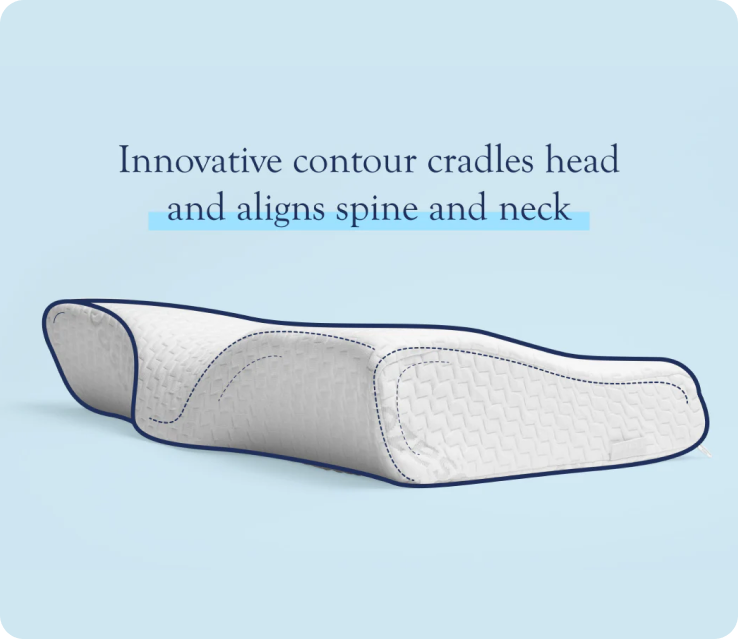
If your main goal is neck support and stable alignment until morning, a true ergonomic cervical pillow is hard to beat. The contoured shape supports the curve of your neck rather than asking your neck muscles to "hold" you in place. That is the difference between a pillow that feels plush and a pillow that keeps posture steady.
Dosaze designs its ergonomic pillows around cervical alignment and pressure relief, with materials chosen for both support and cooling comfort. The practical advantage is consistency: the pillow is shaped to keep your head from drifting into a forward-tilted position as the night goes on. If you are anxious about trying something new, Dosaze offers a 60-night risk-free trial and free shipping & returns, which removes the biggest barrier for most people: "What if it does nothing for my neck?"
Shop the Dosaze Orthopedic Cervical Pillow
2) Contoured memory foam cervical pillow (best for side sleepers with shoulder tightness)
Side sleepers often wake up with shoulder pain because the pillow is too low, or because it compresses and lets the head drop toward the mattress. A contoured memory foam pillow solves this by creating a higher edge for the space between shoulder and head, plus a lower center area so your head is not perched too high.
Look for a contour that matches your body size. If your shoulder-to-neck gap is larger (broad shoulders, firmer mattress, or you sleep with your arm under the pillow), you generally need more loft. If you wake up with ear pressure, numbness, or your jaw feels tight, the contour may be too high or too firm for your build.
3) Low-profile cervical contour pillow (best for back sleepers who get "chin-to-chest" stiffness)
Back sleepers often buy a pillow that is too tall because it feels cozy at first. By morning, the extra height flexes the neck forward, and you wake up with tight suboccipital muscles (that band at the base of your skull). A lower-profile contour with a defined neck roll supports the neck without pushing the head forward.
A good sign is this: when you lie down, your throat feels open, and your chin stays neutral. If you notice you are "looking at your feet" while on your back, the loft is likely too high. If you get a dry mouth because you start mouth-breathing on your back, check whether a too-tall pillow is nudging your head forward.
4) Adjustable loft shredded foam pillow (best for combo sleepers who switch sides at night)
If you rotate between side and back, an adjustable loft pillow can be the most forgiving option. You can remove or add fill so it supports your neck when you are on your side, but does not over-flex your neck when you roll onto your back.
One practical setup that tends to work: set the loft for your side-sleeping first, then remove a small amount (about 10-15% of the fill) to reduce the "neck flex" feeling on your back. Keep the extra fill in a bag so you can adjust after a week. Your body often needs a few nights to stop guarding and relax into the new position.
5) Cooling foam pillow with a breathable cover (best for hot sleepers who toss and lose alignment)
Heat is an alignment problem. If you wake up hot, you change positions more, fluff the pillow, or stack an arm under your head, and that is when neck posture drifts. A cooling foam pillow with a breathable cover can reduce those wake-ups and help you stay in one stable position longer.
When comparing "cooling" claims, look for specifics: ventilated foam holes, a cooling cover fabric, and a feel that stays comfortable after 20 minutes. If the surface starts cool but warms quickly, it may not reduce tossing. For many people, improved temperature comfort equals improved posture consistency, even if the pillow shape is the same. If you want a cooling option you can adjust, consider the Dosaze Thermacool Adjustable Pillow.
6) Latex contour pillow (best for responsive support that does not sink overnight)
Latex has a springier feel than memory foam. For some sleepers, that responsiveness keeps the neck better supported because the pillow "pushes back" instead of slowly letting the head sink. It can be a good match if you dislike the slow-mold feel of memory foam but still want stable cervical support.
Choose latex if your main issue is the pillow losing height by 3 a.m. If you need deep pressure relief at the cheek, memory foam may feel more comfortable. If you need a consistent platform under the neck, latex often holds its shape well across the night.
7) Neck roll plus a flatter pillow (best budget-friendly approach for back sleepers who want more neck support)
If you like your current pillow's feel but your neck needs more support, adding a separate neck roll can improve cervical alignment without replacing everything. The roll fills the curve under the neck, and the flatter pillow supports the back of the head.
This works best for back sleepers and some side sleepers who do not need much loft. The common mistake is using a thick roll that forces the head backward. Start small and adjust. If you feel like your chin points up, the roll is too large for your anatomy.
8) Shoulder cutout or "side sleeper" contour pillow (best for very broad shoulders)
Some side sleepers have broad shoulders and a firm mattress, which creates a large gap from neck to mattress. If a normal contour pillow still feels too low, a pillow with a shoulder cutout can let your shoulder sit closer to the mattress while the pillow supports your neck. Dosaze also makes a contoured orthopedic side sleeper pillow designed for this kind of fit.
It sounds minor, but that cutout can reduce the urge to jam an arm under the pillow, which is a common trigger for morning numbness and neck strain. If you often wake up with your top shoulder rolled forward, a shoulder cutout design may help keep you stacked.
9) Travel cervical pillow for consistent support away from home (best for people who flare up after trips)
Many people sleep "fine" at home and feel awful after one night on a hotel pillow. If your neck pain flares when you travel, it is often because the pillow is too tall, too flat, or too lumpy. A compact cervical travel pillow gives you a known shape and loft anywhere.
The best travel choice mimics your home pillow's neck support. If you use an ergonomic contour at home, look for a travel version with a neck roll rather than a soft U-shaped neck pillow. Soft travel pillows often feel comfortable upright but do little for cervical alignment in bed.
How to choose the right pillow height (without guessing)
Loft is the decision that makes or breaks neck alignment. If you choose the wrong height, even the best materials will not save you. You can get close with one simple rule: your pillow should fill the space between your head and the mattress without lifting your head past neutral.
Use this quick method: measure the distance from the outside edge of your shoulder to the side of your neck while standing relaxed. For many adults, that is roughly 4-6 inches. If you are a back sleeper, your effective gap is smaller, often 2-4 inches depending on head shape and mattress softness.
| If you wake up with... | Your pillow is often... | Try this adjustment |
|---|---|---|
| Neck pain at the base of skull | Too high (back sleeping) or not enough neck support | Lower loft or add a gentle neck roll support |
| Shoulder pain on the side you sleep on | Too low or compressing | Higher contour edge or firmer supportive core |
| Jaw tightness or cheek pressure | Too firm or too high | Lower loft or a pressure relief surface layer |
| Tossing from heat | Too warm | Cooling cover, ventilated foam, lighter bedding |
A contrarian take: "softer" is not always worse for alignment
A lot of pillow advice treats soft pillows as automatically bad for neck support. The real issue is not softness, it is shape retention. A pillow can feel soft at the surface and still keep cervical alignment if it has a supportive core or contour that does not collapse.
This is one reason people bounce between "firm" pillows and still wake up sore. A very firm, tall pillow can hold its shape and still place your neck in the wrong angle. If you remember one thing, make it this: alignment beats firmness. Start with the right height and neck support, then choose the feel you can actually sleep on. If you are deciding between shapes, contoured vs. cervical pillows is a useful comparison.
What makes Dosaze a safer try if you are worried about wasting money
Neck pain makes people cautious, and for good reason. Your body can react strongly to small changes in posture, even when the change is in the right direction. That is why a short "test lay" in the store rarely predicts how you will feel after a full week.
Dosaze reduces that risk with a 60-night risk-free trial and free shipping & returns. It lets you run a real test: 2-3 nights to get used to the new feel, then another week to judge morning stiffness and shoulder tension. If it is not the right fit, you can return it without getting stuck.
View the Dosaze Orthopedic Cervical Pillow
FAQ
What is the best pillow for neck alignment all night?
Neck alignment matters because even a small bend in your neck for 7-9 hours can leave muscles and joints irritated by morning. The best pillow for neck alignment all night is one that keeps your head level with your spine and supports the natural curve of your neck without collapsing, which is why many sleepers do best with an ergonomic cervical contour. A practical next step is to take a side photo while lying in your usual position and confirm your nose lines up with the center of your chest (side sleeping) or your chin stays neutral (back sleeping).
How do I know if my pillow is too high or too low for my neck?
Pillow height matters because it sets the angle of your neck for the entire night. Your pillow is usually too high if your chin tips toward your chest on your back or your head tilts up and away from the mattress on your side, and it is usually too low if your head drops toward the mattress and you feel shoulder strain on your sleeping side. Try adjusting by about 1 inch at a time (or removing 10-15% of fill in an adjustable pillow) and track morning stiffness for 3-5 nights before changing again.
Is a cervical pillow actually better for neck and shoulder pain?
This question matters because "neck pain" can come from poor alignment, pressure points, or both. A cervical pillow is often better for neck and shoulder pain when the pain is driven by poor sleep posture, since the contoured shape supports cervical alignment and reduces the need for your neck muscles to brace all night. If you are a side sleeper with shoulder tightness, choose a contour with enough loft to fill the shoulder-to-neck gap so your head does not sink toward the mattress. For more on picking the right type, see this guide to the best pillow for neck pain.
How long should I try a new pillow before deciding it works?
It matters because your neck can take time to adapt to a new position, even if it is an improvement. Most people should give a new pillow at least 7-14 nights before judging results, because the first few nights can feel "different" as your muscles stop guarding and your posture settles. If your pillow comes with a longer trial period, use it to test multiple positions, and keep notes on morning pain level (0-10) and where you feel it.
What if the new pillow feels uncomfortable or does not help, can I return it easily?
Returns matter because fear of wasting money stops many people from trying the pillow that might actually help. A good return policy makes it safe to test real sleep outcomes, and Dosaze offers a 60-night risk-free trial with free shipping and returns so you can assess neck support and cooling comfort over several weeks. A smart next step is to set a reminder for day 14 to review your notes on morning stiffness and decide whether to keep adjusting or start a return. (You can review details in the Dosaze returns policy.)
Summary of top picks
| Pick | Best for | Why it helps alignment |
|---|---|---|
| Dosaze ergonomic cervical pillow | Most sleepers who want steady cervical alignment | Ergonomic contour supports the neck curve and resists posture drift |
| Contoured memory foam cervical pillow | Side sleepers with shoulder tightness | Higher edge fills the shoulder gap and reduces head drop |
| Low-profile contour pillow | Back sleepers who wake up stiff | Supports the neck without pushing the chin toward the chest |
| Adjustable loft shredded foam | Combo sleepers | Custom height for side and back positions |
| Cooling foam + breathable cover | Hot sleepers | Less overheating means less tossing and steadier posture |
Conclusion and next steps
If you want neck alignment all night, start with shape and height, then choose the feel you can sleep on. Use a quick photo check to confirm your head stays neutral in your main position, and pay attention to whether heat makes you toss and lose posture.
If you want a straightforward option designed around cervical alignment, try an ergonomic cervical pillow with a real at-home test window. The Dosaze Orthopedic Cervical Pillow is built for neck support, pressure relief, and cooling comfort, and it comes with a 60-night risk-free trial plus free shipping and returns so you can assess results without feeling stuck.