



What CertiPUR-US and OEKO-TEX actually tell you about a pillow, and what they do not
Introduction
If you are shopping for a low-odor pillow because you are sensitive to smells, allergies, or headaches, certifications can feel like a shortcut. You see CertiPUR-US on foam. You see OEKO-TEX on fabrics. It sounds like a clear yes or no on safety.
In practice, these labels answer a narrower question: did a specific material pass a specific set of tests at a specific point in time? That is still useful, but it is not the same as "this pillow will be odor-free," "this pillow will fix my neck pain," or "this pillow is best for hot sleepers."
This guide breaks down what each certification covers, what it does not, and how to translate the fine print into a better purchase decision. We will also connect certifications to what most people actually want: ergonomic neck support, cervical alignment, cooling comfort, and an easy way out if the pillow is not right. If you are anxious about spending money and getting no improvement, the goal is simple: help you pick a pillow that has the best odds of working for your body, with low risk.
What a pillow certification is (and is not)
A pillow certification is a third-party standard that tests a defined material, such as polyurethane foam or a textile, for a defined list of chemicals or emissions. It is usually not a full "pillow certification" unless every component is covered and the brand can show what is certified.
Certifications are good at answering "does this meet limits for certain substances?" They are not designed to answer "will it feel comfortable," "will it stay supportive," or "will it smell like nothing on day one." Those outcomes depend on design, density, airflow, covers, adhesives, packaging, and how you use the pillow at home.
CertiPUR-US: what it actually tests
CertiPUR-US applies to flexible polyurethane foam. You will most often see it on memory foam and polyfoam used in pillows, mattress toppers, and mattresses.
At a high level, it is about chemicals and emissions from the foam. It sets limits for certain substances and requires testing for low VOC (volatile organic compound) emissions. It also bans or limits specific flame retardants and heavy metals in the foam.
What CertiPUR-US can tell you
- The foam meets a defined VOC emissions standard (the program references a limit of <0.5 parts per million for VOC emissions). You can read the program details on the official site: https://certipur.us/.
- The foam is made without certain substances the program lists, such as PBDEs, TDCPP, TCEP, mercury, lead, and formaldehyde (as specified by the program).
- The foam has been tested by a participating laboratory under the program's rules, then certified for a set time period (recertification happens regularly).
What CertiPUR-US does not tell you
- It does not guarantee "no smell." Low emissions is not the same as no odor, especially right after unboxing. Packaging, storage time, and your room ventilation matter.
- It does not cover the whole pillow by default. The foam can be certified while the cover, zipper, dyes, thread, and any adhesives are not.
- It does not validate ergonomics. Neck support and cervical alignment come from the pillow's shape, loft, and how it holds your head and shoulders, not from a chemical standard.
- It does not prove "eco-friendly." It is a safety and emissions program for foam, not a full lifecycle environmental assessment.
OEKO-TEX: what it actually tests
OEKO-TEX is a family of standards. The one consumers most often see on bedding is OEKO-TEX Standard 100, which tests textiles and related materials for harmful substances.
Think of OEKO-TEX as a better signal for the parts of a pillow that touch your skin, such as the cover fabric. It can also apply to fillings and foams, but you have to verify what part is certified.
Program overview is here: https://www.oeko-tex.com/en/our-standards/oeko-tex-standard-100.
If you are comparing brands, it also helps to see how a company documents its own testing and scope, for example Dosaze's OEKO-TEX Standard 100 certification page.
What OEKO-TEX can tell you
- The tested material meets limits for a long list of substances (which can include certain pesticides, chlorinated phenols, formaldehyde, and extractable heavy metals, depending on product class and test scope).
- It is better coverage than "organic" claims that only apply to one fiber content line. OEKO-TEX is about finished product safety testing, not just how a fiber was grown.
What OEKO-TEX does not tell you
- It does not automatically mean low odor. A fabric can pass OEKO-TEX and still pick up packaging smells or have a "new textile" scent.
- It does not guarantee cooling. Cooling depends on airflow, surface feel, moisture movement, and how heat builds around your head and neck overnight.
- It is not a performance test. It does not measure loft retention, firmness consistency, or how the pillow supports cervical alignment.
The practical difference: emissions vs. skin-contact safety
If you are a sensitive user chasing a low-odor pillow, the difference matters:
- CertiPUR-US is most relevant to what the foam can emit into the air.
- OEKO-TEX is most relevant to what might be in the fabric and trims that sit against your face and hair.
Neither certification is "better." They answer different questions. A pillow can be a great choice if it has one, both, or neither, depending on what it is made from and how it is built. The smartest move is to treat certifications as one input, then evaluate design and return policy with equal weight.
Where certifications help most for sensitive users
Sensitivity is not one thing. People mean at least three different problems when they say "I need a safe, low-odor pillow."
| Concern | What to look for | What a certification can and cannot do |
|---|---|---|
| Odor triggers (smell sensitivity) | Low-VOC foam, breathable cover, time to air out | CertiPUR-US can indicate low VOC emissions from the foam, but it cannot promise "no smell" on day one. |
| Skin sensitivity | Tested textiles, smooth fabrics, washability | OEKO-TEX can indicate the textile passed harmful substance limits, but it does not guarantee your skin will never react. |
| Allergies (dust mites, pet dander) | Washable cover, good pillow hygiene, encasement if needed | Neither certification stops dust mites. Regular washing and a protective cover matter more. |
The part most blogs skip: why "certified" pillows can still smell
People often assume odor equals "unsafe chemicals." Sometimes it is, but often it is just chemistry plus packaging.
Foam is made through reactions that can leave trace compounds. Even when emissions are low and within limits, your nose can still detect a "new foam" scent. Your sensitivity threshold might be much lower than a lab's pass-fail line.
Packaging adds another variable. A pillow compressed in plastic can trap odors from the foam, cover, or even the bag itself. When you open it, you get a concentrated first hit.
A practical rule from our side of the category: if a pillow arrives tightly packed, plan on a real airing-out window. For many people that is 24-72 hours in a ventilated room. If you are very smell-sensitive, give it longer and keep it out of your bedroom until it settles. (For more detail, see this low-odor pillow guide.)
What matters more than certifications for neck pain: ergonomic shape and fit
If your main goal is less morning neck or shoulder pain, chemical standards are only part of the picture. You need an ergonomic design that holds your neck in a neutral position, so your muscles do not work all night to "brace" your head.
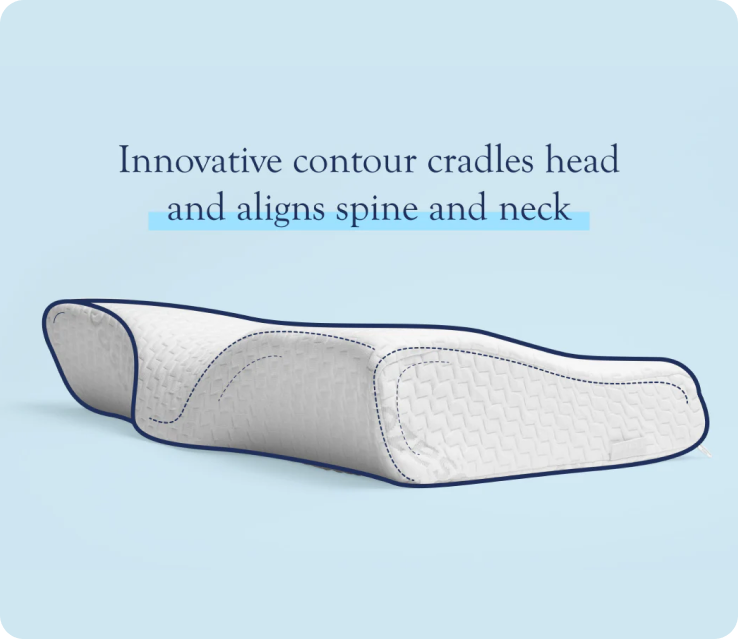
In plain terms, you want steady neck support and consistent cervical alignment. That usually comes from a contoured shape, the right loft for your body, and foam that is supportive enough to prevent collapse. If you are deciding between shapes, this contoured pillow vs. cervical pillow breakdown helps clarify the fit differences.
A quick fit check you can do at home
- Side sleeper: your nose should point straight out, not down into the pillow or up toward the ceiling. Your neck should feel filled in, not hanging.
- Back sleeper: your chin should not tilt toward your chest. Your neck curve should feel supported, not pushed forward.
If you pass a safety standard but fail this fit check, you can still wake up sore.
Cooling and "eco-friendly" claims: what to verify
Hot sleepers often search for an "eco-friendly pillow" because they want a cleaner, simpler product. The tricky part is that "eco-friendly" is not a single measurable claim. It can mean fewer chemical concerns, fewer odors, less waste, or longer durability.
For hot sleepers, cooling is usually more measurable than "eco." Look for details you can feel:
- Airflow: a design that does not trap heat around your face.
- Surface feel: a cover that stays cool to the touch longer, especially if you run warm.
- Pressure relief without sink: deep sink can feel cozy for 10 minutes, then hot at 3 a.m.
Durability is an under-rated eco factor. A premium pillow that keeps its shape longer can mean fewer replacements, less waste, and more consistent neck support over time.
Where to start (a simple decision path)
If you are overwhelmed by labels, start with your sleep position and your main complaint.
- If you wake with neck pain: prioritize ergonomic contour and cervical alignment first, then look for safety certifications as a bonus.
- If you are smell-sensitive: prioritize low emissions foam, breathable construction, and a return policy you trust.
- If you sleep hot: prioritize cooling feel and airflow, then confirm the materials meet your personal safety bar.
Then de-risk the decision. A trial period matters because comfort and neck support are personal. You cannot fully predict it from a spec sheet.
How Dosaze thinks about this: design first, then materials, then risk
At Dosaze, we see a pattern in customer messages: people do not only want a "safe" pillow. They want a pillow that feels comfortable on night one and still gives neck support on night thirty.
That is why we focus on ergonomic design for sleep posture, then pair it with materials chosen for support and cooling comfort. The last piece is reducing purchase anxiety with a 60-night risk-free trial and free shipping & returns, so you are not stuck if your body says "no." (You can review the details on the Returns policy.)
Two Dosaze options for ergonomic neck support
Both pillows below are built for cervical alignment and pressure relief. The right pick depends on your sleep position, your shoulders, and how much contour you like.
| Pillow | Best for | What it feels like | Why people choose it |
|---|---|---|---|
| The Original Contoured Orthopedic Pillow | Back and side sleepers who want a clear contour | Structured support that cradles the neck | Helps keep the head level and reduces the "gap" under the neck that can drive morning stiffness |
| Cervical Orthopedic Pillow by Dosaze™ | People who want more focused cervical support | More targeted support under the neck curve | Chosen by customers who feel most discomfort right at the base of the skull or upper neck |
How to judge a "low-odor" pillow like a sensitive user
If odor is your main anxiety, you need a plan that goes beyond checking a logo.
- Ask what is certified. Foam-only certifications do not cover the cover. Fabric-only certifications do not cover the foam.
- Assume some new-product scent. Even premium foam can smell "new" at first, especially after compression packaging.
- Control your first exposure. Open the pillow in a ventilated room, let it expand, and give it time before sleeping on it.
- Use the trial as your safety net. A 60-night risk-free trial with free shipping & returns changes the math for sensitive users because you can evaluate it in your real bedroom.
Advanced: the trade-off between pressure relief and cooling
Memory foam can feel great for pressure relief because it molds around your head and neck. The same deep contour can reduce airflow and trap heat. That trade-off is why hot sleepers sometimes think "foam equals hot," even though material choices and design details can change the outcome.
If you sleep hot and have neck pain, aim for a pillow that gives cervical alignment without letting your head sink too far. In our experience, the best balance feels supportive first, then comfortable. If it feels like your head disappears into the pillow, you may get warmth buildup and a bent neck angle.
FAQ
What safety certifications should I look for if I need a low-odor pillow?
This question matters because "low odor" is about what materials can emit into the air, not just what touches your skin. A practical baseline is CertiPUR-US for polyurethane foam and OEKO-TEX Standard 100 for fabrics, because those programs set limits for VOC emissions (foam) and harmful substances (textiles). Even with certifications, plan to air the pillow out for 24-72 hours in a ventilated room after unboxing, since packaging can concentrate odors.
Does CertiPUR-US mean a pillow is safe for people with allergies or sensitivities?
Sensitive sleepers often need clarity on what a certification does and does not cover. CertiPUR-US means the foam meets specific limits for certain chemicals and VOC emissions under that program, but it does not certify the cover fabric, and it does not guarantee you will have zero odor or zero reaction. If allergies are your concern, pair certified materials with a washable cover and consistent pillow hygiene, because dust mites and dander are usually the bigger triggers than foam chemistry.
Is an OEKO-TEX pillow better for skin sensitivity and allergies?
This matters because skin sensitivity is often driven by what is in the textile dyes, finishes, and trims that touch your face. OEKO-TEX Standard 100 indicates the tested textile product met limits for many harmful substances, which can make it a safer choice for skin-contact materials. It does not prevent dust mites or pet allergens, so washing the cover regularly and keeping hair and skincare products off the pillowcase can be just as important.
What is a good eco-friendly pillow choice for hot sleepers with allergies?
People ask this because they want fewer irritants and less heat buildup, but "eco-friendly" claims vary a lot between brands. A good practical choice is a durable, supportive ergonomic pillow with cooling-focused materials and a washable cover, since longevity and washability often reduce waste and allergen load more than a vague "green" label. If you are unsure on comfort, choose a pillow with a real in-home trial, like Dosaze's 60-night risk-free trial with free shipping & returns, so you can test cooling and neck support in your own bedroom.
How do I know if an ergonomic pillow will actually help my neck pain?
This matters because neck pain relief depends on fit, not on marketing claims. An ergonomic pillow is a good match if it keeps your head level (side sleeping) or your chin neutral (back sleeping) while filling the space under your neck for steady cervical alignment. The most reliable test is sleeping on it for several nights and checking morning stiffness, which is why an extended trial period is more meaningful than a quick in-store squeeze.
Conclusion and next steps
CertiPUR-US and OEKO-TEX are useful, but they are not a full answer. CertiPUR-US is most helpful for understanding foam emissions and certain chemical limits. OEKO-TEX is most helpful for understanding fabric safety against a long list of substances.
If your goal is better sleep and fewer morning aches, put ergonomic design first. Then use certifications to narrow the field, especially if you are smell-sensitive or have skin concerns. Finally, protect yourself with a return policy that makes testing low risk.
- If you want a contoured shape for neck support and cervical alignment, start with The Original Contoured Orthopedic Pillow.
- If you want more focused cervical support, look at the Cervical Orthopedic Pillow by Dosaze™.
- If odor is your main worry, plan a 24-72 hour airing-out period after unboxing and use the 60-night risk-free trial and free shipping & returns to evaluate it at home.


