



7 Best Pillows for Side Sleepers: Find Your Perfect Match
If you sleep on your side and your lower back or hips ache, the pillow under your head is only part of the fix. Most of the relief for the back and hips comes from a second pillow: a firm one between your knees, or a body pillow you can hook your top leg over. That stops your top leg from dropping across your body and twisting your pelvis. The head pillow keeps your neck level with the rest of your spine. For most side sleepers that means a medium-firm pillow with a medium-high to high loft (roughly 4 to 6 inches) in memory foam, latex or an adjustable shredded fill.
Why side sleeping can hurt your lower back and hips
With nothing between your legs, your top knee slides forward and down until it rests on the mattress. Your top hip rolls with it, and your lower back twists to follow. Hold that for a few hours and you can wake with a sore lower back, an ache on the outside of the top hip, or both.
The bottom hip has a different problem, because it carries much of your weight. On a mattress that's too firm it presses into a hard surface all night. On one that's too soft, your hips sink lower than your shoulders and your spine bends sideways.
A head pillow at the wrong height adds to it. If your head tips down toward the mattress or gets pushed up, your neck bends, and people often shift their shoulders and hips to compensate without noticing.
The pillow setup for side sleepers with back and hip pain
- Put a firm pillow between your knees. It should be thick enough to keep your knees about hip-width apart, so your top thigh stays level instead of angling down. A soft pillow flattens and stops working within an hour. Contoured knee pillows from many brands are shaped to stay in place, but a firm standard pillow does the same job.
- Try a body pillow if you move around a lot. A long body pillow keeps the top knee raised and gives your top arm somewhere to rest, which stops that shoulder rolling forward. It takes up a lot of bed, so it suits a queen or king better than a full.
- Bend your knees slightly. Pulling them up toward your chest rounds the lower back.
- If there's a gap under your waist on a firm mattress, a thin pillow or rolled towel there can stop your middle from sagging.
- Pick a head pillow that keeps your neck straight (more on loft below).
Dosaze doesn't sell a dedicated knee pillow or body pillow, so use what you have or buy that piece elsewhere. The head pillow is where we can help, and you can see the full range in our pillow collection.
Dosaze head pillows that suit this setup
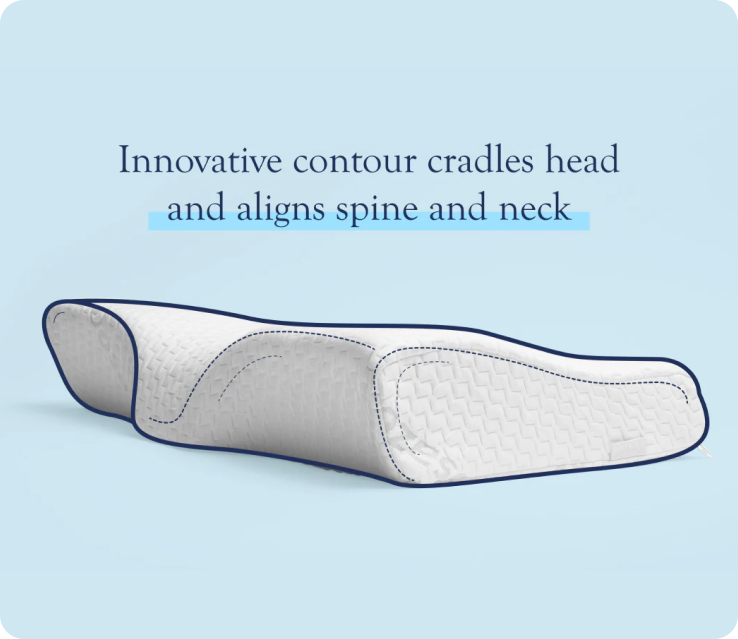
The Dosaze Contoured Orthopedic Pillow is memory foam shaped to cradle the natural curve of your neck and designed to support spinal alignment. It works for side sleepers as well as back and stomach sleepers. The cover is a naturally cooling, anti-microbial fabric that comes off for washing, it's OEKO-TEX Standard 100 certified, and the foam is CertiPUR-US certified. The Dosaze OrthoCurve Pillow carries the same description. The trade-off with any contoured pillow is that the shape is fixed: if its height doesn't match your shoulders, you can't change it.
If you aren't sure what loft you need, the Dosaze Adjustable Pillow lets you add or remove its gel-infused memory foam fill, and extra foam comes in the box. It's made in the USA, has no polyester fill and is queen size (18 x 26 inches). The Dosaze ThermaCool Adjustable Pillow is the other adjustable option, with a ventilated gel core and adjustable cooling fill for people who run hot.
The Dosaze Therapeutic Cooling Wedge Pillow is built for sleeping elevated on your back, so it isn't a side-sleeping pillow. Its description does suggest slipping it under your legs for lumbar relief while lounging, which can be useful if you read or watch TV in bed. The Alignment Kit pairs it with the Contoured Orthopedic Pillow.
If your neck and shoulders hurt too
Shoulder pain in side sleepers often comes from the bottom shoulder taking weight, made worse when the pillow is too low and you shove your arm under it for height. A pillow with enough loft lets your arm rest in front of you instead.
For neck pain, contour (cervical) pillows are the usual suggestion. They're higher at the edge under your neck and lower where your head rests, so the neck curve is supported without any adjusting. Expect a few nights to get used to one. They also feel awkward if you roll onto your back or stomach during the night, since the shape is set up for one position at a time.
Types of pillows for side sleepers compared
| Type | Feel | Suits | Downside |
|---|---|---|---|
| High-loft memory foam | Slow sink, even pressure, medium-firm to firm | Neck or shoulder pain, broad shoulders | Solid foam holds heat unless gel-infused or open-cell |
| Shredded memory foam | Contouring, adjustable soft to firm | Anyone who hasn't found the right height | Fill shifts and needs fluffing |
| Latex | Buoyant, pushes back quickly | People who change position or dislike feeling stuck in foam | Heavy, often pricier; avoid natural latex with a latex allergy |
| Contour / cervical | Firm, pre-shaped | Recurring neck stiffness | Adjustment period; poor for combination sleepers |
| High-loft down alternative | Soft, traditional | People who want plush and sleep cool | Cheaper versions flatten fast |
| Buckwheat | Very firm, moldable | Hot sleepers who like sculpted support | Heavy and rustles when you move |
| Body pillow | Depends on fill | Hip or lower back pain, pregnancy | Takes a lot of bed space |
A few details the table can't hold. With down alternative, look for a gusseted or box-wall design (a fabric strip around the edge that gives the pillow side walls), because a plain flat-sewn pillow won't hold side-sleeping height for long. Buckwheat hulls lock into whatever shape you push them into and air moves freely between them, which is why hot sleepers like them. Latex is naturally breathable and resists dust mites.
And memory foam is the most common choice for a reason: it fills the gap between head and mattress without collapsing by 2 a.m.
How to pick the right loft
- Shoulder width sets the gap your pillow has to fill. Broader shoulders need more height, narrower frames less.
- Your mattress changes it. A softer mattress lets your shoulder sink in, so you may need a slightly lower loft. A firmer mattress keeps you higher, so you need more.
- Aim for medium-firm to firm. A pillow that compresses easily loses its height partway through the night.
- Check it in position. Lie on your side and have someone look (or take a photo): your nose should line up with the middle of your chest, and your neck shouldn't bend up or down.
- Think about heat. Your face is pressed into the pillow, so gel-infused foam, latex or a breathable cover helps if you sleep warm.
When the mattress is the problem
If your bottom hip still aches after you've sorted the pillows, look at the mattress. A mattress that's too firm for side sleeping pushes back hard on the hip and shoulder, and a mattress topper adds a softer layer on top. A topper won't fix a mattress that sags in the middle, though. In that case the hips sink no matter what's on top, and replacing the mattress is the real answer.
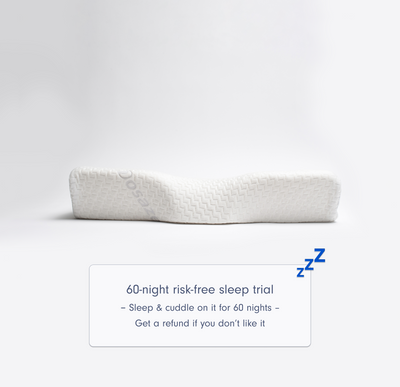
A new pillow can take a week or more to feel normal as your neck adjusts. Dosaze pillows come with a 60-night sleep trial; the details are on our FAQ page.
Frequently asked questions
Should side sleepers with lower back pain put a pillow between their knees?
Yes, it's one of the simplest changes to try. A firm pillow between the knees keeps your top leg from dropping forward, which stops your pelvis rotating and your lower back twisting. It should be thick enough to keep your knees roughly hip-width apart.
What height pillow does a side sleeper need?
Most side sleepers need a medium-high to high loft, roughly 4 to 6 inches, but shoulder width and mattress firmness change that. Broad shoulders and firm mattresses call for more height, while a soft mattress lets the shoulder sink and needs less. An adjustable pillow lets you add or remove fill until your neck is level.
Can the wrong pillow cause hip pain?
A head pillow at the wrong height can make you shift your shoulders and hips to compensate, but hip pain in side sleepers more often comes from the legs and mattress. Without a pillow between the knees, the top hip rolls forward. A mattress that's too firm presses on the bottom hip, and one that's too soft lets the hips sink.
Is memory foam or latex better for side sleepers?
Both can work at the right loft. Memory foam sinks slowly and spreads pressure evenly, but solid foam can feel warm unless it's gel-infused. Latex feels bouncier, makes it easier to change position and breathes well, though it's heavier and often costs more.
What pillow helps side sleepers with neck and shoulder pain?
Look for a medium-firm pillow high enough that you don't need to tuck your arm under it. Contour pillows support the curve of the neck with a raised edge, though they take a few nights to get used to. If you aren't sure of the height, an adjustable shredded foam pillow lets you tune it.


