



Best Pillow for Side Sleepers: How to Pick the Right Loft and Fill
The best pillow for side sleepers fills the space between your ear and the mattress, usually 4 to 6 inches once your head is on it, and is firm enough that it doesn't flatten overnight. That height depends on your shoulder width and your mattress, so an adjustable pillow is the safest pick for most people. A contoured memory foam pillow suits side sleepers who already know the height they need. A wedge only makes sense if you also want your upper body raised.
Why side sleepers need a different pillow
On your side, your head sits several inches above the mattress, held up by the width of your shoulder. The pillow has to fill that gap so your neck stays in line with the rest of your spine. With too little loft your head drops toward the mattress. With too much it gets pushed up toward the ceiling. In both cases the muscles on one side of your neck work all night, and that is often where morning stiffness comes from.
Side sleeping also adds pressure points that back sleepers don't have. Your ear and jaw rest on the pillow, and your lower shoulder carries body weight. A pillow that is too hard presses on the ear, and one that is too soft lets your head sink until the shoulder is jammed up underneath.
How much loft you need
Loft is the height of the pillow while you're lying on it, not its height on the shelf. Two things set it:
- Shoulder width. Broad shoulders create a bigger gap and need a taller pillow. Someone with a narrow frame may be comfortable nearer 4 inches.
- Mattress firmness. On a firm mattress your shoulder stays on top of the surface, so you need more loft. A soft mattress lets the shoulder sink in, which shrinks the gap.
To check, lie on your side in your own bed and have someone look at you from behind (a photo works too). Your neck should run in a straight line with your upper back. If your head tilts down, add height. If it tilts up, take some away.
This is why no single pillow is the best for every side sleeper. Change your mattress and the right loft can change with it.
Firm or soft pillows for side sleepers
Most side sleepers do better on a medium-firm to firm pillow. A soft pillow can feel right when you first lie down, then compress under your head over several hours and leave your neck unsupported by morning.
Squeezing pillows in a store is a poor guide. The one that feels plush in your hand is often the one that bottoms out. You want a pillow that pushes back under your head, with enough give at the surface that your ear isn't pressed against something hard. And if you're shopping for a firm pillow, check the height too: a firm pillow at the wrong loft still bends your neck.
Pillow fills compared
| Fill | Height | Feel | Suits | Watch for |
|---|---|---|---|---|
| Adjustable memory foam | Add or remove fill | Molds to head and neck | Side sleepers unsure of their loft, or between sizes | A few nights of trial and error; may need fluffing |
| Solid or contoured memory foam | Fixed | Close contour that doesn't shift | People who know their height and want no upkeep | Loft can't be changed; dense foam can sleep warm without a cooling cover |
| Latex | Usually fixed (shredded versions adjust) | Bouncy, pushes back quickly | Warm sleepers, people who switch between side and back | Heavier; less contouring than memory foam |
| Down alternative | Fixed, compresses | Soft and light | People who like a soft pillow and don't mind fluffing | Loses height overnight; often too flat for broad shoulders |
Heat matters more on your side than you might expect, because your cheek and ear press into the pillow all night. Gel-infused foam, ventilated cores and breathable covers all help. New foam pillows can also have a smell for the first day or two, and airing the pillow out before use usually clears it.
Dosaze pillows for side sleepers
If you're not sure what height you need
The Dosaze Adjustable Pillow is filled with cooling gel-infused memory foam that you can mold, add or remove to change the height. Extra foam comes in the box, which helps if you have broad shoulders or a firm mattress and need more loft than the pillow arrives with. It's queen sized (18" x 26"), made in the USA, with no polyester fill. Plan on a few nights of adjusting before it sits right. That trial and error is the trade for a height matched to your body.
If firmness is your main concern, the Dosaze ThermaCool Adjustable Pillow pairs a ventilated gel core, designed to cycle hot air away, with an adjustable cooling fill that lets you change firmness as well as height.
If you want a fixed shape
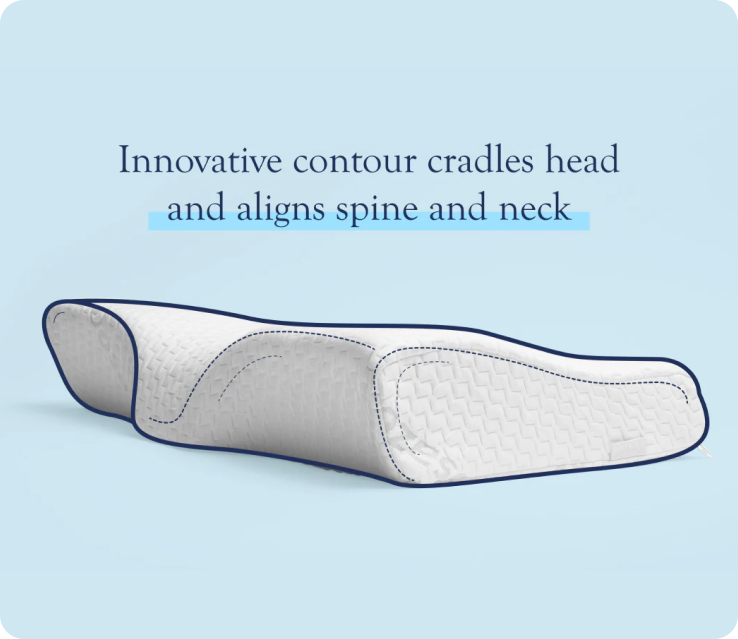
The Dosaze Contoured Orthopedic Pillow is solid memory foam shaped to cradle the curve of your neck and promote spinal alignment. It works for side sleepers as well as back and stomach sleepers. The cover is naturally cooling, anti-microbial and removable for washing; the pillow is OEKO-TEX Standard 100 certified and the foam is CertiPUR-US certified. Solid foam doesn't shift or need fluffing, so the support at 5 a.m. matches the support at 11 p.m. But you can't change the height, so if your shoulders are very broad or your mattress is very firm, an adjustable pillow gives you more room to get it right.
Wedge pillows for side sleepers
A wedge raises your chest as well as your head, on a slope, instead of only propping up your head. That's the point if you want to sleep elevated. The Dosaze Therapeutic Cooling Wedge Pillow was designed by ergonomists for sleeping at an incline, and its description lists reducing acid reflux and GERD symptoms. It has a cooling gel layer and a nanoporous cover that wicks heat and moisture. You can sleep on your side on a wedge, but the slope doesn't fill the shoulder gap on its own, so most side sleepers still put a regular pillow on top. Dosaze sells the contoured pillow and wedge together as the Alignment Kit for that reason. If you don't need elevation, skip the wedge.
Your mattress is half of the setup
No pillow fully makes up for a mattress that lets your hips sag or holds your shoulder too high. Side sleepers usually need enough give at the shoulder and hip for both to sink in a little, plus enough support through the middle of the body to stop a hammock-like dip. If you move from a firm mattress to a softer one (or add a topper), recheck your pillow height, because the gap under your head gets smaller.
Put a pillow between your knees
Lower back stiffness, rather than neck pain, often points lower down. On your side, your top leg falls forward and twists the pelvis. A firm pillow between the knees keeps your hips and lower spine level, and you can try it tonight with a spare pillow before changing anything else.
When to replace your pillow
Pillows last roughly 1 to 2 years, and well-made memory foam and latex can last longer. Go by how the pillow performs, not the date. Replace it if it has lumps, no longer holds its height, or you're waking with stiffness you didn't have when it was new. For fiber and down alternative pillows, fold it in half and let go; if it doesn't spring back, it's done. Solid foam won't fold, so press a hand into it and watch whether it returns to shape.
If you've slept on a flat pillow for years
Some side sleepers do sleep well on a low pillow. Bodies differ, and most people roll between positions during the night. But plenty of people treat a stiff neck as normal and never connect it to a flat pillow. If you wake up sore, height is the first thing to change.
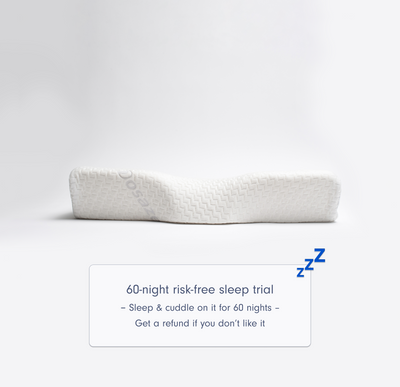
Give any new pillow more than a week, since your neck needs time to adjust to a different height. Dosaze pillows come with a 60-night sleep trial, with details on our FAQ page. You can compare every option in the Dosaze pillow collection.
Frequently asked questions
What pillow height is best for side sleepers?
Most side sleepers need about 4 to 6 inches of loft once their head is on the pillow. Broader shoulders and firmer mattresses push you toward the top of that range, while narrow shoulders or a soft mattress need less. An adjustable pillow lets you fine-tune the height instead of guessing.
Should side sleepers use a firm pillow?
Usually yes. A medium-firm to firm pillow holds its height under the weight of your head, while a soft one can flatten over the night. Firmness only helps if the loft is right, though, so check both.
Can you sleep on your side on a wedge pillow?
You can, but a wedge raises your upper body on a slope and doesn't fill the gap between your shoulder and head by itself. Most side sleepers add a regular pillow on top of the wedge. A wedge is worth it mainly if you want to sleep elevated.
Is memory foam or latex better for side sleepers?
Memory foam contours closely to the head and neck, and adjustable versions let you change the height. Latex is bouncier and more breathable but heavier and less contouring. Warm sleepers often lean toward latex or toward memory foam with cooling gel and a breathable cover.
Does a pillow between the knees help side sleepers?
It can help keep your hips and lower spine level, because your top leg otherwise falls forward and twists the pelvis. It's a cheap first thing to try if you wake with lower back stiffness. Any firm pillow works for a test.


