



Best Pillow for Side Sleepers: Your Top Questions Answered
The best pillow for most side sleepers is a medium-firm to firm pillow about 4 to 6 inches high that fills the space between your ear and the mattress, so your head stays level with your spine instead of tipping up or down. Contoured memory foam and adjustable shredded memory foam are the two types that most often get this right, because one holds a set shape all night and the other lets you add or remove fill until the height fits your shoulders. The rest of this page covers how to pick the right height and firmness for your body, which fills suit which sleepers, and what to change if you still wake up sore.
Which type of pillow is best for side sleepers?
Each common fill handles the side-sleeping problem differently. The table compares them on the things side sleepers ask about most.
| Pillow type | Height control | Feel | Best for | Trade-off |
|---|---|---|---|---|
| Contoured (solid) memory foam | Fixed | Firm, slow to sink, shaped to the neck | People whose height needs are already clear and who want the same support every night | If the height is wrong for your shoulders, you can't change it. Solid foam can also hold heat. |
| Shredded or adjustable memory foam | Add or remove fill | Moldable, medium to firm depending on fill | Anyone still working out their ideal height, or couples with different frames | Takes a few nights of adjusting. The fill shifts and needs an occasional shake. |
| Latex | Usually fixed | Springy, pushes back quickly | Side sleepers who run warm or dislike the slow sink of memory foam | The bounce feels odd to some people at first. |
| Down alternative | Fluff to adjust, but it flattens | Soft and light | People with narrow shoulders who want a soft pillow | Compresses under the head through the night. Look for a high fill if you choose one. |
For most side sleepers, a contoured foam pillow or an adjustable shredded foam pillow gives the best mix of support and comfort. Down alternative works for some, but it is the fill most likely to go flat by 3 a.m.
Why side sleepers need a taller pillow
Lie on your side and there is a gap between your head and the mattress roughly as wide as your shoulder. Back and stomach sleepers don't have that sideways gap, which is why their pillows are usually thinner. A side sleeper's pillow has to fill it.
If the pillow is too flat, your head drops toward the mattress and the neck bends down. Too thick, and it angles your head up toward the ceiling. Either way the neck muscles spend the night holding a bent position, and that tension tends to show up as stiffness in the morning.
How high should a side sleeper's pillow be?
Most side sleepers do well with 4 to 6 inches of loft. Where you land in that range depends mainly on your frame: broad shoulders need more height, while smaller frames often need less.
Two quick checks, both done lying on your side:
- Your nose should line up with the center of your chest, not point above or below it.
- Your ear, shoulder and hip should form a roughly straight line. A partner can check this more easily than you can.
Your mattress changes the answer
A soft mattress lets your shoulder sink further in, which shrinks the gap your pillow has to fill. On a soft bed you may need a pillow toward the lower end of 4 to 6 inches; on a firm one, toward the higher end. If you are replacing both, think of them together. The Dosaze mattress collection is a place to start if your current bed is part of the problem.
How firm should it be?
Medium-firm to firm. A soft pillow can measure 5 inches on the shelf and compress to 2 under the weight of your head, which puts you back in the too-flat position. Firm doesn't have to mean hard against your face, though. You want a pillow that holds its height while the surface still gives a little where your cheek and ear rest.
If you find yourself folding the pillow in half or punching it into a ridge during the night, it is usually too soft or too thin.
What makes a pillow comfortable for side sleeping
Support is half of it. The other half is how the pillow feels against your face for seven or eight hours.
Side sleepers press one cheek and ear into the pillow for long stretches, and heat builds up in that spot. Solid memory foam is the fill most likely to trap it. If you sleep warm, look for gel-infused foam, a ventilated core, shredded fill (air moves between the pieces) or a breathable cover made from bamboo-derived or moisture-wicking fabric. Latex also tends to sleep cooler than traditional memory foam.
Size matters less than people expect. A standard or queen pillow gives enough surface for your head and neck; you don't need a king unless you move around a lot.
Dosaze pillows that suit side sleepers
Three pillows in our range are designed with side sleepers in mind. Which one fits depends mostly on whether you already know the height you need.
Dosaze Contoured Orthopedic Pillow
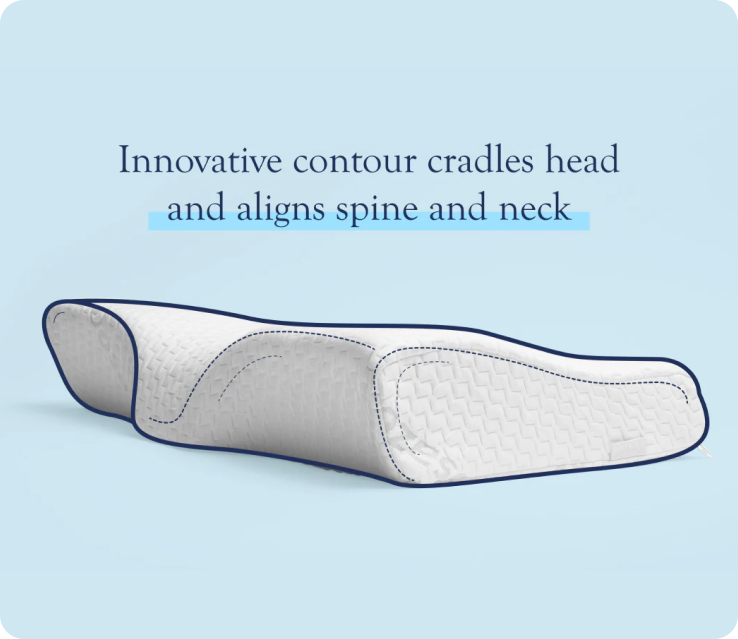
The Contoured Orthopedic Pillow is a shaped memory foam pillow designed to cradle the natural curve of your neck and promote spinal alignment. It works for side, stomach and back sleepers, has a naturally cooling, anti-microbial fabric and a removable cover you can wash. The foam is CertiPUR-US certified and the pillow is OEKO-TEX Standard 100 certified. It suits side sleepers who want a firm, consistent shape. Because the height is fixed, it is a less forgiving choice if you are unsure what loft you need.
Dosaze Adjustable Pillow (Made in the USA)
If you are still working out your height, the Dosaze Adjustable Pillow lets you add or remove fill. The fill is cooling gel-infused memory foam (no polyester), the pillow is fully moldable, and extra foam comes with every pillow, so you can go taller if you have broad shoulders. It is a queen size, 18 by 26 inches, with a silky, hypoallergenic cover, and it is made in the USA.
Dosaze ThermaCool Adjustable Pillow
For hot sleepers, the ThermaCool Adjustable Pillow combines a ventilated gel core designed to cycle hot air with an adjustable cooling fill you can use to set the firmness. The memory foam is CertiPUR-US certified, and it is designed for side, back and stomach sleepers.
Our wedge and travel pillows are built for other jobs (sleeping elevated, and resting upright on a plane or in a car), so they are not the pick for nightly side sleeping. You can compare everything in the Dosaze pillow collection.
Can the wrong pillow cause neck or shoulder pain?
It can contribute, and people often don't connect morning soreness to their pillow. When your head isn't held level, your neck muscles work through the night to compensate.
The shoulder you lie on takes direct pressure too. A pillow that is too high or too rigid pushes your head up and adds strain along the side of the neck into that shoulder. Signs your pillow may be part of the problem:
- You wake with a stiff neck or a headache
- The arm you slept on is numb or your shoulder aches
- You fold, flip or punch the pillow during the night
- The pillow is more than 1 to 2 years old and noticeably flatter than when new
A better pillow won't fix every cause of pain. If your shoulder still hurts after the pillow height is right, check whether your mattress gives enough at the shoulder, and talk to a doctor if the pain keeps up.
Put a pillow between your knees
The head pillow handles the top of the spine. The lower half needs help as well. Without anything between your knees, your top leg slides forward and down, twisting the pelvis and pulling on the lower back over the night. A firm pillow between the knees keeps the hips stacked. A standard pillow folded for height does the job if you don't own a knee pillow.
Some side sleepers prefer a full-length body pillow, which supports the knees, gives the top arm somewhere to rest so it doesn't drop forward and pull on the shoulder, and makes it harder to roll onto your back. It is also useful if you drift between side and back sleeping.
When to replace your pillow, and how to judge a new one
Plan on replacing a pillow every 1 to 2 years. Memory foam and latex usually last longer than down or polyester. To check yours, fold it in half and let go: a pillow in good shape springs back, while a worn one stays folded or feels lumpy. Lingering odors and stains are other reasons to replace it.
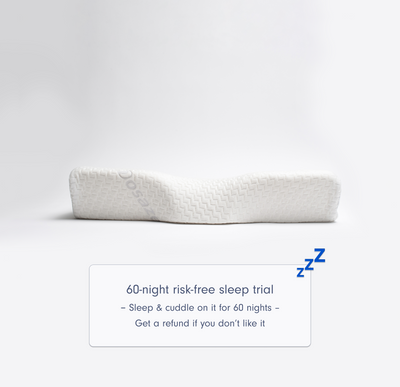
Give a new pillow several nights before deciding, since your neck needs time to adjust to a different height. Pay attention to how you feel on waking, and whether you are still reshaping the pillow at night. Dosaze pillows come with a 60-night sleep trial, and the details are on our FAQ page.
Frequently asked questions
Is memory foam good for side sleepers?
Memory foam is one of the most common choices for side sleepers because it holds its height under the weight of your head and contours to the neck. Solid foam keeps the same shape all night, while shredded foam lets you adjust the height. The main downside is heat, so hot sleepers should look for gel-infused foam, shredded fill or a cooling cover.
Should side sleepers use one pillow or two?
One pillow of the right height is usually better than stacking two, because stacked pillows shift apart and leave a gap under the neck. If one pillow is too thin, an adjustable pillow you can fill higher is a more stable fix. A second pillow is useful between your knees rather than under your head.
Is a soft or firm pillow better for side sleepers with shoulder pain?
Medium-firm usually works best. A very soft pillow lets the head sink and bends the neck down, while a very high or rigid one pushes the head up and adds strain toward the lower shoulder. Aim for a pillow that keeps your head level with your spine, and check that your mattress lets your shoulder sink in a little.
What pillow should I use if I switch between side and back sleeping?
Combination sleepers often do well with an adjustable pillow, since you can set it to a middle height that suits both positions. A contoured pillow designed for side and back sleeping is another option. Back sleeping generally needs a bit less height than side sleeping, so avoid the very thickest pillows.


