



Waking Up With Stiff Neck? Match the Fix to the Cause
If you keep waking up with a stiff neck, the usual cause is that your neck spent several hours bent or twisted. A pillow that is too high or too low for how you sleep, a pillow that flattens out by 3 a.m., sleeping on your stomach, a sagging mattress, or dozing off upright on a couch or plane can all do it. Morning stiffness from sleep position tends to ease as you move around. If it doesn't fade within a few days, follows an injury, or comes with numbness, tingling down an arm, fever or a severe headache, see a doctor before buying anything.
For everyone else, the useful step is to work out which of those causes is yours. They need different fixes, and a new pillow only solves some of them.
Read the pattern before you buy anything
Your stiffness usually leaves clues. Go through these and see which fits:
- Stiff on one side, and it's the side you sleep on. Your pillow is probably the wrong height for the width of your shoulders, so your head tips down toward the mattress or gets pushed up toward the ceiling.
- Stiff after nights you end up on your stomach. Your head is turned 90 degrees to one side for hours. No pillow fully cancels that out.
- Fine at bedtime, stiff by morning, and the pillow looks flat. Fold it in half. If it stays folded instead of springing open, the fill has broken down and stops holding your head up partway through the night.
- Stiff neck plus a sore lower back. Look at the mattress. If it dips where your hips sit, your whole spine curves and your neck compensates.
- Only stiff after a nap on the couch, a flight or a long drive. Your bed setup may be fine. Your head dropped sideways while you slept sitting up.
- It started right after you switched pillows. A new pillow, especially a firmer or contoured one, can feel odd for the first week or two. Persistent stiffness after that usually means the height is off.
What matters when choosing a pillow for morning stiffness
Height that matches your sleep position
This matters more than anything printed on the label. Side sleepers need the pillow to fill the gap between the mattress and the side of the head, which is roughly the distance from your neck to the edge of your shoulder. Broad shoulders need more height. Back sleepers need less, enough to support the curve of the neck without pushing the chin toward the chest. Stomach sleepers need the least, and many do better with a very thin pillow.
Does it hold that height until morning?
Down and polyester fiber pillows compress and shift during the night. Memory foam, whether a solid contoured block or shredded fill, keeps its shape better, which is why so many neck-focused pillows use it. Solid foam is the more consistent of the two. Shredded foam can be reshaped, though it also moves around more.
Fixed shape or adjustable
A fixed contoured pillow is predictable: the shape is the shape. If its height happens to suit you, that's ideal. If it doesn't, you can't change it. Adjustable pillows let you remove or add fill until the height is right, which helps if you're between sizes, switch positions during the night, or have bought pillows before that didn't work.
The main options compared
| Type | Suits | Watch out for |
|---|---|---|
| Contoured memory foam | Back and side sleepers who want the same support every night | Height can't be changed; takes some nights to get used to |
| Adjustable shredded foam | Combination sleepers, people unsure of the right height | Needs some trial and error; fill can shift |
| Standard fiber or down | People who like a soft, squashable pillow and have no stiffness | Flattens overnight; needs replacing sooner |
| Wedge pillow | People who need to sleep with the upper body raised | Not a neck pillow; a tall pillow on top can push your chin down |
| Travel neck pillow | Stiffness after sleeping upright on planes, cars or trains | Only helps sitting up |
| Mattress topper | A mattress that has softened or dips in places | Won't fix a mattress with deep sagging |
Plenty of brands make each type (Tempur-Pedic is known for contoured foam, Coop for adjustable shredded foam), so the type matters more than the name on it.
Where Dosaze fits
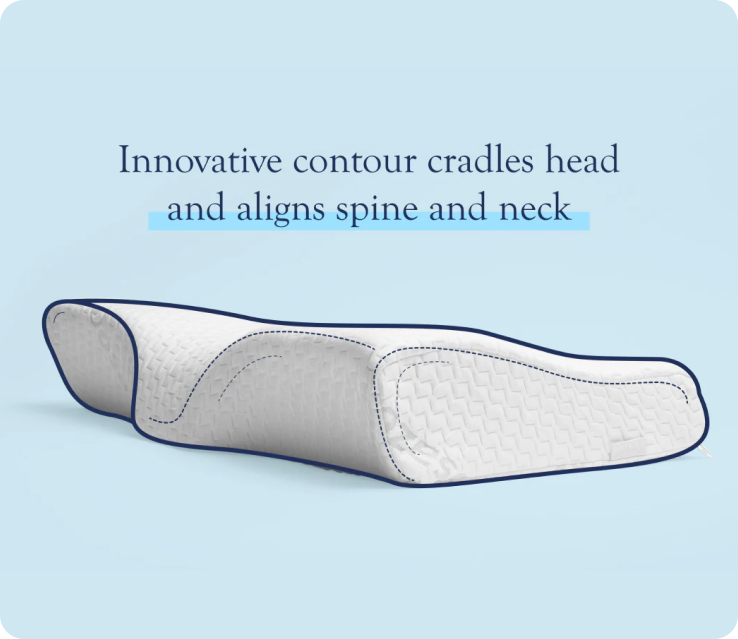
If you sleep on your back or side and want a pillow that keeps its shape, the Dosaze Contoured Orthopedic Pillow is a memory foam pillow shaped to cradle the curve of the neck and promote spinal alignment. It has a naturally cooling, anti-microbial cover that comes off for washing, the fabric is OEKO-TEX Standard 100 certified, and the foam is CertiPUR-US certified. The OrthoCurve Pillow shares the same design. The catch is the fixed height. If you have very broad or very narrow shoulders and the contour doesn't line up with your neck, you can't adjust it.
That's the case for the Dosaze Adjustable Pillow (Made in the USA). It's filled with cooling gel-infused memory foam that you can take out or add back, and extra foam comes with every pillow. It's a queen size (18 by 26 inches). Expect to spend a few nights adjusting before you find your height. If you also sleep hot, the ThermaCool Adjustable Pillow has a ventilated gel core and adjustable cooling fill with full firmness control.
If your stiff neck only shows up after travel, the Dosaze Travel Neck Pillow gives 360-degree neck and chin support with an adjustable velcro closure, so your head stays upright instead of dropping to one side.
The Therapeutic Cooling Wedge Pillow isn't designed for neck stiffness. It raises your upper body, which some people need for reflux or snoring. If you sleep on one, use a low pillow on top so your chin doesn't end up tucked toward your chest.
When a new pillow won't fix it
Stomach sleeping is the big one. Even a good pillow leaves your head rotated for hours. Some people retrain themselves by starting the night on their side with a pillow hugged against the chest, which makes rolling face-down less comfortable. It takes a while.
A mattress that sags will undo any pillow. If your mattress is still structurally sound but has gotten softer, a mattress topper can firm up the surface. If there's a visible dip, a topper only hides it for a while.
And stiffness that comes with numbness, weakness, fever or pain after a fall or accident is a medical question, not a bedding one.
Giving a new pillow a fair trial
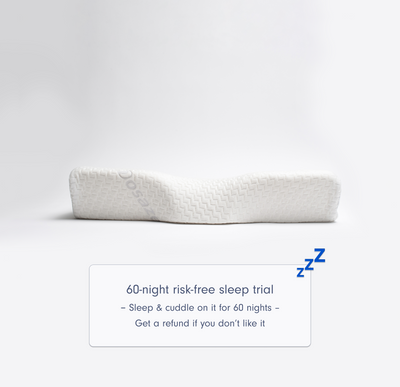
Your neck has gotten used to the old setup, so the first few nights on a different pillow can feel strange even if it's a better fit. Give it a couple of weeks before judging. With an adjustable pillow, change the fill a handful at a time rather than all at once, and note how you feel each morning. Dosaze pillows come with a 60-night sleep trial; details are on our FAQ page. You can compare every option in our pillow collection.
Frequently asked questions
How long does a stiff neck from sleeping wrong usually last?
Stiffness from an awkward sleep position often eases within a few hours of moving around and usually clears in a day or two. If it lasts more than a few days, keeps getting worse, or comes with numbness, tingling, fever or a bad headache, see a doctor.
How do I know if my pillow is too high or too low?
Lie in your usual position and have someone look at you from the side or the end of the bed. Your nose should line up roughly with the center of your chest, and your head shouldn't tilt up toward the ceiling or down toward the mattress. If it tilts, the height is wrong for you.
Should I sleep without a pillow to fix a stiff neck?
For most back and side sleepers, no. Without a pillow the head drops and the neck bends, which can make stiffness worse. Some stomach sleepers do better with no pillow or a very thin one because it reduces how far the neck bends back.
Can my mattress cause a stiff neck?
It can. If the mattress sags under your hips or shoulders, your spine curves and your neck ends up at an angle even on a good pillow. Waking with both a stiff neck and a sore lower back is a common sign that the mattress is part of the problem.
How often should I replace my pillow?
Replace it when it no longer holds its shape. A simple check for fiber pillows is to fold them in half: if the pillow stays folded, the fill has broken down. Memory foam lasts longer but should be replaced if it develops permanent dents or lumps.


